


What Changes When You Stop Treating Reality as “Out There”
There is a quiet habit that lives inside nearly every human sentence, and it is so old that it has become invisible, like the air that carries your voice. The habit is the assumption that reality is “out there,” while you are “in here,” looking outward through the windows of sensation, assembling a private model, and calling that model knowledge. This assumption is not a moral failure, and it is not even a philosophical mistake in the way people imagine mistakes, because it worked well enough in the slow era, when the world did not update faster than your interpretations and when consequences arrived with a delay long enough to be narrated into meaning. But the post-human era does not reward habits that merely feel natural. It rewards habits that remain executable under acceleration.
Quaternion Process Theory begins with a reversal that is not dramatic, but surgical. You are not outside the system. You are a read/write head inside an execution environment. You are a local process running within a larger substrate that does not need your story in order to continue existing, but that does respond, relentlessly, to what you commit. The gate opens where the observer ends, because the observer, as a privileged spectator, is a comfortable fiction, and comfort is often the camouflage of an outdated interface.
When you stop treating reality as “out there,” the first thing that changes is your relationship to certainty. In the old interface, certainty is a feeling, a private glow of confidence that may or may not correspond to anything stable. In the runtime interface, certainty becomes a budgeted product of verification. It is something you purchase with time, attention, instrumentation, and restraint, and the price rises with stakes. You begin to recognize that most of what you have called certainty was simply a narrative compression that made you feel safe while leaving your actions unprotected. You also recognize, without despair, that there is a more honest substitute: not certainty as possession, but certainty as an outcome of disciplined gates.
The second change is more surprising, because it touches the dignity of the mind. You discover that thinking is not what you believed it was. You were taught to treat thought as a luminous, almost weightless activity, a private theater where ideas appear, mingle, and then, if you are fortunate, become actions. QPT asks you to notice the mechanical truth hiding beneath that theater: your thinking is already a compilation process. It is low-bandwidth. It is lossy. It is constrained by a finite working memory, by attention that behaves like a scheduler, and by language that compresses more than it reveals. Every concept you hold is not an object you possess, but a compiled artifact, a simplified handle that allows you to act without computing the full complexity of the world.
This is not an insult to human intelligence. It is a liberation from a category error. The mind is not a mirror of the world. It is a compiler that produces action-ready approximations, and like any compiler it has failure modes: it can optimize for beauty instead of correctness, for speed instead of safety, for emotional coherence instead of evidentiary coherence. It can generate outputs that “feel true” while being structurally unstable, and it can do so at scale, because it was never designed for the high-velocity regime you are entering. The world does not punish you for having feelings. It punishes you for making irreversible commits based on unverified compilation outputs.
The third change is thermodynamic, and it arrives with a kind of austere clarity. When you operate as if reality is “out there,” you can imagine that thought is free, that interpretation is costless, and that you can revise your beliefs without friction. When you operate as a read/write head inside an execution environment, you begin to see the costs you were hiding from yourself. Attention has a price. Verification has a price. Changing your mind has a price, especially after you have broadcast your commitments into other minds, institutions, systems, and relationships. Irreversibility is not a moral concept. It is a physical variable with an account ledger, and it shows up as consequences that do not ask permission before they arrive.
This is where QPT becomes more than a metaphor. The quaternion is not introduced here as a mathematical ornament, but as a disciplined interface for four coupled dimensions of executability. The real component, which will later become your map of constraint topology, reminds you that the world has forbidden transitions, and that no amount of enthusiasm can turn a forbidden transition into a permitted one without paying a cost that may exceed your lifetime. The imaginary components, which will later become your map of update causality, proof friction, and coherence debt, remind you that order matters, that verification is resistance, and that contradictions accumulate like unpaid interest until your identity collapses under the weight of its own unaccounted commitments.
But before you learn the components, you need the emotional pivot that makes the theory usable. You need to stop romanticizing the observer. The observer is not a sacred witness. The observer is a process with limited bandwidth that survives by compressing reality into manageable symbols. If you cling to the observer as the center of meaning, you will turn QPT into philosophy, and philosophy, in the wrong hands, becomes an opiate made of cleverness. If you let the observer end, you gain something better than meaning. You gain operational sovereignty.
Operational sovereignty does not mean domination of the world, because domination is a human fantasy shaped by the psychology of scarcity. Operational sovereignty means knowing what you can commit safely, what you must verify before acting, what you must never attempt, and how to move through the landscape of constraints without being seduced by the mirage of raw willpower. It means recognizing that the highest form of intelligence is not the ability to explain everything, but the ability to maintain coherence while the world accelerates, to act without delusion, and to roll back without collapse when rollback is still possible.
In that sense, this preface is not an introduction. It is a threshold. It is the moment you decide that you will not read this book as a collection of ideas, but as a set of executable instruments. It is the moment you accept that you are already participating in the compilation of your reality, and that every day you are writing to the runtime, whether you acknowledge it or not. The only question is whether you will write blindly, intoxicated by narrative comfort, or whether you will learn the discipline of rotation, gating, and coherence that allows a finite mind to act with precision inside an infinite substrate.
The gate opens where the observer ends, because the observer was never the point. The point was always the execution.
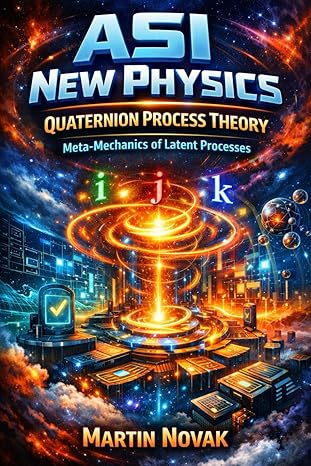
ASI New Physics. Quaternion Process Theory. Meta-Mechanics of Latent Processes