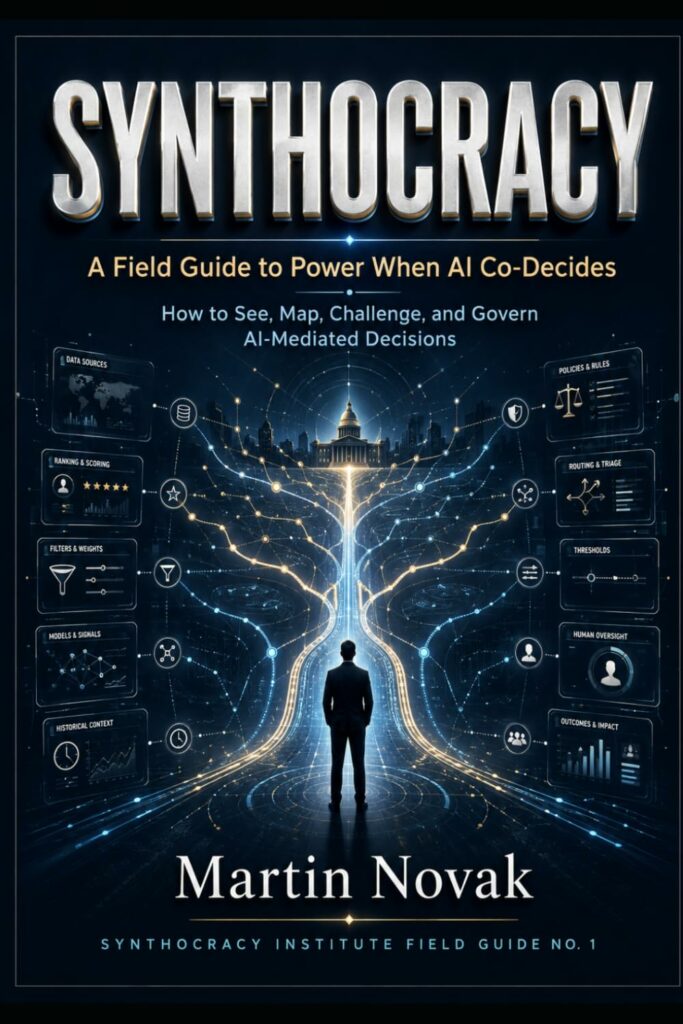









SYNTHOCRACY: A STEP-BY-STEP GUIDE. When Does AI Stop Assisting and Start Co-Deciding?
Not every use of artificial intelligence is an exercise of decision power. An AI system that corrects grammar, translates a document, reformats a report, locates a file, or organises notes may make human work easier without materially changing what is decided. Treating every AI-assisted task as “co-decision” would make the concept so broad that it would cease to be useful. The opposite mistake is equally serious: assuming that AI co-decides only when a machine independently issues the final yes or no. Between harmless assistance and fully automated decision-making lies a much larger territory in which AI shapes what becomes visible, how options are ordered, which cases receive attention, how evidence is weighted, what recommendation appears credible, which route becomes available, or whether an action occurs at all. The purpose of the Material Influence Test is to locate that boundary. The Field Guide defines this as the first practical diagnostic threshold of the Synthocracy framework: the reader should neither call every AI use co-decision nor restrict co-decision to fully automated final decisions.
ASSISTANCE — AI is assisting when it supports a human task without materially altering the consequential decision field: what becomes visible, comparable, prioritised, admissible, recommended, routed, approved, or executed.
CO-DECISION — AI is co-deciding when its operation materially changes the path or probable outcome of a consequential decision, even if a human retains formal authority and performs the final approval.
This distinction is functional, not rhetorical. A vendor may call a system an assistant, copilot, decision-support tool, workflow accelerator, or productivity platform. None of those labels determines what the system actually does inside the process. A product called a copilot may merely draft text, or it may decide which applicants reach a hiring manager. A system described as “support” may produce a risk score that determines whether a citizen enters additional investigation. A tool formally presented as a recommendation engine may establish a default that humans almost never overturn. The relevant question is therefore not what is the system called? It is what changes because the system is there? The Field Guide makes this functional shift explicit and identifies five particularly important families of operations: filter, rank, classify, route, and execute. Summarising, recommending, and predicting can also become co-decision depending on where they sit in the process and how strongly they influence what follows.
The Boundary in One Example
Suppose a company receives 2,000 applications for a job. An AI translation system translates applications submitted in several languages so that the recruiter can read all of them. The system has influenced the presentation of the information, but if the translations preserve the applications and every candidate remains available for human consideration, the system is primarily assisting.
Now change one function. The AI scores all 2,000 candidates and forwards only the highest-ranked 50 to the recruiter.
The human still interviews candidates. The human still chooses the winner. The human may even genuinely exercise judgment among the fifty people visible on the screen. But the system has already helped determine the population from which the decision can be made. The other 1,950 candidates may never be considered by a person.
The difference is not that translation is inherently harmless and ranking inherently harmful. The difference is material influence on the decision field.
Translation preserved access to consideration.
Ranking determined access to consideration.
That is the boundary we need to learn to see.
The Material Influence Test
THE MATERIAL INFLUENCE TEST — An AI system should be treated as participating in co-decision when its operation materially changes one or more consequential properties of the decision process: visibility, order or priority, evidentiary weight, a threshold or classification, the available option set, the route or tempo of the process, the probability of approval or rejection, or the direct execution of an action.
“Material” is the important word. A change can occur without being decisionally significant. Changing a font does not usually alter authority. Correcting punctuation usually does not alter access. Sorting documents alphabetically may have no meaningful effect on the result. But changing which documents a reviewer sees, which person appears first, which case receives a warning label, which claim crosses an investigation threshold, or which patient enters an urgent queue can alter the practical conditions of decision.
The test therefore does not ask whether AI was present somewhere in the workflow. It asks whether the workflow would be meaningfully different for the decision or for the person affected if the AI operation were removed, changed, or reversed.
This gives us a useful counterfactual question:
If this AI operation were removed, would substantially the same evidence, people, options, priorities, routes, and actionable choices still reach the relevant decision-maker in substantially the same way?
If the answer is clearly yes, the system is more likely to be assisting. If the answer is no, because removing the AI changes who is seen, what counts, what receives priority, what becomes the default, who gets access, or what action occurs, the system has moved toward co-decision.
The test is a diagnostic instrument within the Synthocracy framework, not a legal definition or a substitute for jurisdiction-specific analysis. The Field Guide explicitly treats its tools as aids for observation, mapping, and preliminary governance review rather than formal conformity assessments.
Five Verbs That Reveal Co-Decision
The easiest way to detect material influence is often to stop talking about “AI” in the abstract and describe the system with verbs.
Filter. A filtering system determines what passes through and what does not. Filtering spam, duplicate records, or corrupted files may be ordinary housekeeping. Filtering becomes decisionally significant when it determines which person, application, document, product, claim, transaction, or signal receives institutional attention. A recruitment system may exclude applications lacking a recognised qualification. A fraud system may separate transactions into ordinary and suspicious sets. A procurement agent may remove suppliers whose certifications are not machine-readable. A public-service workflow may classify a case as incomplete before any official sees it. The system has not formally rejected anyone, but it can exercise power by preventing them from becoming visible to someone who could decide differently. As the Field Guide puts it, filtering can become a power over admission to the decision field.
Rank. Ranking determines order. In low-stakes settings, order may be convenient rather than consequential. In scarce-attention environments, however, order can become opportunity. If a recruiter reviews only the first fifty applicants, a ranking helps determine who is considered. If investigators review the highest-risk cases first, a ranking changes scrutiny. If a platform places some sellers, posts, or products far above others, ranking changes visibility. A system does not need to prohibit an option to reduce its practical chance of being chosen. It may simply place it where almost nobody reaches it.
Classify. Classification assigns a person, case, transaction, document, or event to a category. Categories can be useful organisational tools, but they become decisionally powerful when different categories trigger different treatment. “Routine,” “high risk,” “priority,” “suspicious,” “eligible,” “incomplete,” “likely fraud,” or “requires review” are not merely descriptions if institutional workflows behave differently because of them. A probability produced by a model can therefore produce a categorical institutional consequence.
Route. Routing determines where something goes next. A well-designed routing system may improve access by directing a citizen to the correct service or a customer to the relevant department. But routing becomes co-decisional when different routes carry different delays, evidence requirements, degrees of human attention, prices, opportunities, or chances of success. A person need not be formally excluded to receive materially worse access. The system may simply send them into a different corridor.
Execute. Execution is the clearest case. An AI agent may send a message, place an order, transfer funds, modify a record, schedule an action, reject a request, suspend an account, publish content, or interact with another system. Once AI moves from producing information to causing authorised changes in the world, its relation to decision power becomes more direct. But execution is the end of the spectrum, not the beginning. Synthocracy matters precisely because material power can arise long before execution.
The verbs do not imply that the system possesses intention, consciousness, political identity, or moral responsibility. They describe institutional functions. Humans and organisations still choose objectives, procure systems, define categories, configure thresholds, accept defaults, decide where outputs enter workflows, and determine what authority systems receive. Operational influence is not the same thing as sovereignty.
The Harder Verbs: Summarise, Recommend, Predict
Filtering, ranking, classifying, routing, and executing are often relatively easy to identify. Three other functions are more ambiguous because they can be either simple assistance or substantial co-decision: summarising, recommending, and predicting.
A summary can save time while preserving the underlying record. It can also replace the record in practice. Imagine a judge, doctor, regulator, manager, or public official facing hundreds of pages of material. If AI creates a short summary but the reviewer independently examines the relevant underlying evidence, the system may remain primarily assistive. If the summary becomes the only representation of the record the human actually reads, then the system has gained a much stronger role: it determines what survives compression and what disappears from the practical evidence environment.
Search works similarly. A legal research assistant that helps a lawyer locate a document is not equivalent to a system that silently determines which evidence appears in the review file. The first helps the human reach information. The second helps determine the information from which the human constructs reality.
Recommendation is equally context-dependent. A music recommendation that can be ignored without consequence is different from an AI-generated recommendation that appears at the top of a clinical, financial, administrative, or employment workflow and requires a reviewer to justify any departure. The word recommendation sounds soft, but institutional force can make it hard.
Prediction adds another layer. A system may estimate that a transaction is fraudulent, a worker is likely to leave, a borrower may default, a patient is likely to deteriorate, or a citizen presents elevated risk. The prediction may be probabilistic, but the institutional response to it can be categorical. A person predicted to be risky may face more scrutiny. A worker predicted to leave may receive fewer opportunities. A customer predicted to be less profitable may receive different terms. A patient predicted to be low priority may wait longer. The forecast then begins to alter the world it claimed merely to describe. The Field Guide highlights this exact mechanism: predictive influence can move institutions from reacting to what people have done toward acting on futures attributed to them.
For these ambiguous functions, the Synthocracy framework uses two additional variables: position and force.
POSITION — Where does the AI operation sit in the decision chain? Is it an optional aid before independent review, or does it determine what reaches the decision-maker at all?
FORCE — How strongly does the AI operation influence what happens next? Can it be ignored easily, or does it change a default, threshold, evidentiary burden, tempo, route, probability of approval, or execution?
The same technological capability can therefore be assistive in one institutional design and co-decisional in another.
Translation Is Not Ranking
Consider two uses of the same language model in recruitment.
In the first, the model translates a candidate’s CV from Polish into English. The recruiter receives the translated text alongside the original. The candidate remains in the same pool. The translation does not score, exclude, reorder, or recommend. This is predominantly assistance.
In the second, the model analyses the CV, compares it with a job description, assigns a suitability score, and moves only candidates above 80 percent to human review. This is not merely a more advanced version of translation. It performs a different institutional function. It establishes a threshold controlling admission to human attention.
The distinction is not about model sophistication.
A simple rule-based filter can exercise more decision power than an extraordinarily capable language model used only for translation.
Capability and decision authority are different variables.
Grammar Correction Is Not Risk Scoring
Suppose an official writes a report and uses AI to correct spelling and grammar. The system improves expression but leaves the underlying assessment untouched. Assuming the correction does not alter meaning, the AI is assisting the communication of a decision made elsewhere.
Now suppose another system assigns the subject of the report a risk score. That score triggers enhanced scrutiny, delays the process, requires additional evidence, or frames the person as suspicious before a reviewer examines the case.
The system has still not issued the final determination. Yet it has changed the evidentiary posture of the person. The Field Guide notes that risk scoring can shift the practical burden of proof without any visible policy announcing that such a burden has moved. A person who would otherwise proceed normally may suddenly need to explain inconsistencies, produce historical records, or wait for additional checks.
The number can therefore influence the decision long before a formal finding exists.
Search Assistance Is Not Evidence Selection
An AI search tool may help a lawyer, doctor, scientist, investigator, or civil servant find relevant material more quickly. If the professional can formulate different searches, inspect sources, see uncertainty, expand the search, and independently evaluate the material, the tool may remain largely assistive.
But now imagine that the system searches a large evidentiary record and automatically selects the twenty items most relevant to a decision. The reviewer receives only those twenty. Thousands of other items remain technically available somewhere but are never examined.
Nothing has been formally deleted.
Yet the practical evidence environment has changed.
This is one of the most important forms of upstream power because the human may believe they are exercising independent judgment while their epistemic field has already been narrowed. The issue is no longer simply whether the AI produced an accurate output. The issue is what was allowed to become evidence for the human decision at all.
A Summary for Convenience Is Not a Summary That Becomes the Case
The distinction becomes even clearer with summarisation.
A busy official receives both a complete file and an AI-generated two-page summary. The summary helps navigation, but disputed or important points are checked against the original material. The AI assists.
Now imagine that the institution processes such volume that the complete files are almost never read. Human reviewers make decisions from machine-generated summaries because there is no practical time for anything else.
Formally, the record still exists.
Formally, the human may still have access to it.
Operationally, the summary has become the case.
At that point, omission becomes a form of influence. What the summariser selects, compresses, foregrounds, or leaves out can materially shape how the human understands the situation. This is why formal access to original information is not sufficient by itself. What matters is how the process actually operates.
An Optional Recommendation Is Not a Default
Recommendations also vary in force. A user browsing a bookstore may receive a list of suggested books and ignore all of them. The recommendation affects visibility but may carry little consequential force.
Now move the same mechanism into a hospital, bank, court, insurer, government department, or hiring system. The AI recommends “approve,” “reject,” “investigate,” “high risk,” “priority,” or “not suitable.” The recommendation is displayed prominently. Human staff process hundreds of cases every day. Departures from the recommendation require written justification and additional approval.
The human can technically disagree.
But disagreement is institutionally expensive.
This is the point at which formal discretion and effective discretion begin to diverge. The existence of an override button tells us less than how realistically it can be used.
A later article in this series will examine this problem through the concept of the Ceremonial Human. For the Material Influence Test, the important question is simpler: does the recommendation alter the probability of what happens next? If it does so materially, it belongs within the decision analysis.
An Informational Chatbot Is Not an Acting Agent
A public-service chatbot that tells a citizen where to find a passport form is usually assisting access. It provides information, and the citizen continues through an established process.
Now imagine an AI agent that interprets the citizen’s request, checks eligibility, retrieves records, decides which documents are sufficient, selects a route, submits the application, schedules an appointment, and automatically closes cases that fail a validation rule.
The conversational interface may look almost identical.
The institutional function is entirely different.
The first system speaks about the process.
The second system participates in the process.
This distinction will become increasingly important as AI shifts from output to actuation. But the same Material Influence Test still applies: what did the system cause to become visible, admissible, prioritised, routed, approved, or executed?
Auxiliary Scoring Is Not an Elimination Filter
A score can also have different meanings depending on how it is used. A recruiter might receive an AI-generated relevance score alongside every candidate and treat it as one uncertain signal among many. The system influences attention, so it deserves examination, but its role may remain bounded.
If the same score is used to eliminate everyone below a threshold before human review, the architecture changes. The number has become a gate.
The distinction is not primarily mathematical. It is institutional.
A score used as evidence is different from a score used as admission.
A prediction available to a reviewer is different from a prediction that controls the route.
A recommendation open to disagreement is different from a recommendation automatically executed.
This is why the Material Influence Test examines function in context, not model type.
Material Influence Can Exist Without Visible Harm
Co-decision should also not be confused with wrongdoing. An AI routing system might materially determine which hospital department receives a patient and do so extremely well. A procurement system might eliminate suppliers that genuinely fail mandatory safety requirements. A fraud model might identify cases that deserve human investigation. A ranking system might help an overwhelmed public office handle urgent applications first.
These can all involve material decision influence.
That does not make them inherently illegitimate.
The purpose of identifying co-decision is not to condemn the system. It is to identify when stronger questions of evidence, oversight, authority, appeal, auditability, and reversibility become relevant. The Institute’s public framework explicitly describes synthocracy as a condition to be examined, not a verdict. AI can improve institutions; the problem arises when its participation in consequential power becomes invisible, unaccountable, or practically impossible to challenge.
This yields an important distinction:
Co-decision is a description of influence, not a finding of illegitimacy.
A transparent, well-governed AI system may participate materially in a decision and still be valuable. Conversely, a supposedly minor “assistant” may create serious governance problems if its outputs quietly become indispensable defaults.
Consequence Changes the Governance Burden
The same degree of AI influence also matters differently depending on what is at stake. A recommendation about the order of songs in a playlist does not require the same institutional controls as a ranking that affects access to employment, credit, healthcare, public benefits, legal status, education, housing, or personal liberty.
The Synthocracy corpus therefore separates whether AI co-decides from how serious that co-decision is. The first is a functional diagnosis. The second depends on consequence, reversibility, scale, vulnerability, and available remedies. Earlier work in the project treats low-risk internal and reversible assistance differently from systems affecting money, employment, health, legal position, reputation, public administration, or access; systems capable of autonomous rejection, sanction, payment, deletion, publication, or irreversible action demand stronger controls.
This prevents another common error: assuming that the word co-deciding must be reserved only for catastrophic or high-risk AI. A system can materially co-decide in a mundane commercial process. The classification tells us where power entered. Risk analysis tells us how much governance that power requires.
A Practical Reading of the Test
When examining a real system, begin without asking whether it uses “AI.” Instead reconstruct what it does to the decision environment.
Ask whether it changes visibility: who or what reaches human attention.
Ask whether it changes order: what appears first, receives priority, or waits.
Ask whether it changes classification or threshold: who enters which category and what follows from crossing a line.
Ask whether it changes evidentiary weight: which facts, signals, summaries, scores, or predictions become more authoritative than others.
Ask whether it changes the option set: what choices remain practically available.
Ask whether it changes the route: which workflow, queue, level of scrutiny, reviewer, service, or procedural path applies.
Ask whether it changes the probability of approval or rejection: whether the system creates a default or anchor that humans routinely follow.
Ask whether it changes execution: whether the system can itself cause an authorised action.
The more of these properties the system materially changes, the stronger the case that we have moved from assistance toward co-decision.
But there is no need to force every system into a binary category. Some arrangements are genuinely borderline. The point of the test is not to create artificial certainty. It is to make the relevant dimensions visible enough for institutional examination.
The Threshold in One Sentence
The dividing line can now be stated compactly:
AI stops being merely assistive and begins to co-decide when its contribution no longer just helps a human perform the same decision process, but materially changes the information, people, options, priorities, thresholds, routes, probabilities, or actions from which the consequential outcome is produced.
This is why translation is not equivalent to ranking candidates, grammar correction is not equivalent to risk scoring, and search assistance is not equivalent to deciding which evidence reaches a reviewer. The difference is not that one technology is “AI” and the other is not. Both may use the same model. The difference lies in their relationship to the decision.
The question we should carry forward is therefore not:
Did AI make the final decision?
It is:
What would have been seen, compared, prioritised, recommended, admitted, routed, approved, or executed differently without the AI operation?
When the answer is something consequential, we have reached the territory of co-decision.
And once we enter that territory, the next analytical step is unavoidable: we must stop examining the model in isolation and reconstruct the entire decision chain.