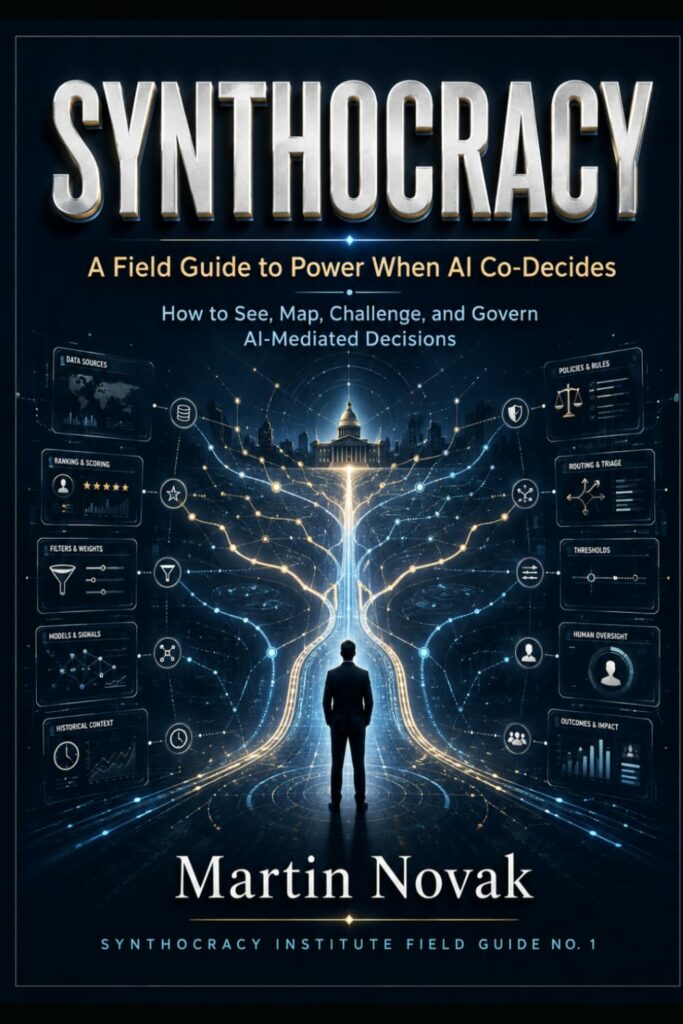









SYNTHOCRACY: A STEP-BY-STEP GUIDE. Series Introduction
Twenty Articles on Power, AI, Decision-Making, and the Emerging Decision Order
Artificial intelligence is usually introduced through capability. We ask what models can write, predict, search, diagnose, generate, automate, negotiate, or execute. We compare benchmarks, discuss jobs, debate AGI, measure productivity, and watch increasingly autonomous systems move from producing answers to performing actions.
This series begins somewhere else.
It begins with power.
What happens when artificial intelligence becomes part of the machinery through which people are seen, classified, ranked, prioritised, recommended, routed, approved, rejected, monitored, and acted upon?
What happens when a human still formally makes the decision, but an AI system has already determined which information reaches that human, which options appear, how alternatives are ordered, which risks are highlighted, which people become visible, and which route a case follows?
What happens when AI no longer merely produces information but begins to execute actions on behalf of individuals, companies, platforms, and governments?
And what kinds of rights, evidence, institutional controls, and forms of accountability are needed when decision-making power becomes distributed across humans and machines?
These are the questions behind synthocracy.
The central proposition of this series is simple:
Power does not disappear when decisions become AI-mediated. It changes interface.
Synthocracy is a name for an emerging decision order in which humans may formally remain responsible and in authority while AI systems increasingly perform consequential parts of the work through which decisions are prepared, structured, recommended, routed, or executed. The concept therefore does not require an AI president, a machine sovereign, or the disappearance of human institutions. It begins much earlier—when AI acquires material influence over the path through which decisions are made.
The purpose of SYNTHOCRACY: A STEP-BY-STEP GUIDE is to explain this emerging field from the beginning.
No previous knowledge is required.
The twenty articles are arranged as a progression. The first articles establish the language. The next explain the mechanics of AI-mediated decision-making. The middle of the series examines the position of humans, institutions, states, companies, and increasingly autonomous agents. The later articles turn to meaningful human authority, evidence, contestability, market access, and governance. The final article moves deliberately from analysis of the present into explicitly labelled foresight.
The result is intended to function as a public entry point into the wider Synthocracy research programme: neither a manifesto nor a prediction of an inevitable future, but a structured guide to recognising where power moves when AI begins to co-decide.
How to Read the Series
The articles are designed to be read in sequence, but each also stands on its own.
A reader arriving through search may begin with an article about the Ceremonial Human, the Synthote, the Algorithmic State, or AI agents without having read everything that came before. Each article therefore defines the concepts it needs and links them back to the larger architecture.
Read from beginning to end, however, the series follows a deliberate path:
definition → decision mechanics → human position → institutional power → agentic action → authority → evidence → rights → markets → futures.
That order matters.
Synthocracy should not become a vocabulary that requires ten invented terms before a newcomer can understand the first one. Each concept should appear only when an observable problem creates a reason to name it.
The series therefore begins with the most basic question:
What is synthocracy?
It ends with a much more difficult one:
What kinds of decision orders could emerge if increasingly capable AI systems become permanent participants in government, markets, institutions, and everyday life?
Between those two questions lies the field.
The Twenty Articles
1. What Is Synthocracy? A Step-by-Step Introduction
The foundational article.
It defines synthocracy in one sentence and then develops the definition gradually. It explains why AI does not need to make the final decision in order to co-decide, why the visible human signature may reveal only the last stage of a much longer process, and why the movement of power into filtering, ranking, scoring, recommendation, and routing requires a new analytical lens.
The article also introduces the principle that anchors the entire series:
Power does not disappear. It changes interface.
It explains the genealogy of the term, the specific definition used by the Synthocracy Institute, what synthocracy does not mean, and the simplest example of an AI-mediated decision.
2. Synthocracy vs AI Governance, Technocracy, Algorithmic Governance, and AI-tocracy
The second article places synthocracy within the existing conceptual landscape.
Artificial intelligence already has a large governance vocabulary. We speak of AI governance, automated decision-making, algorithmic governance, platform governance, digital government, technocracy, responsible AI, AI safety, and increasingly AI-tocracy.
These concepts overlap, but they do not ask exactly the same question.
This article explains what each term describes, where the fields intersect, and what synthocracy adds: a focus on the distribution and movement of practical decision-making power when AI becomes part of consequential decision processes.
Its purpose is not to replace established terminology but to show precisely where synthocracy belongs.
3. When Does AI Stop Assisting and Start Co-Deciding?
Not every use of AI is an exercise of power.
A spelling assistant is not equivalent to an automated employment filter. Translation is not the same as risk scoring. Summarising information for convenience is not necessarily the same as deciding which evidence a reviewer will ever see.
The third article introduces the critical boundary between assistance and co-decision.
Its core concept is the Material Influence Test: would changing or removing the AI contribution materially alter the evidence, options, visibility, priority, route, recommendation, execution, or outcome?
This distinction prevents the concept of synthocracy from becoming so broad that every use of AI counts as governance.
4. The AI-Mediated Decision Chain: Where Power Actually Moves
A final decision is usually only one point in a larger process.
This article follows that process from beginning to end:
objective → data → classification → filtering → ranking → summarisation → recommendation → routing → decision → execution → consequence → appeal → feedback.
It shows how power can enter at many stages before anyone formally decides anything.
The article establishes one of the core methods of synthocracy research: follow the decision chain rather than looking only at the signature at the end.
5. The Decision Field: How AI Shapes Choices Before a Decision Is Made
Human choice always takes place inside an environment.
Some information is visible. Other information is absent. Some options appear first. Others appear last. Some risks are highlighted. Some are barely mentioned. Defaults reduce friction in one direction and increase it in another.
AI systems increasingly help construct this environment.
This article introduces the decision field: the structured space of information, options, rankings, defaults, recommendations, thresholds, and attention within which a later human choice occurs.
It asks:
Who shaped the field before the person chose?
6. The Ceremonial Human: Responsibility Without Real Control
A person can remain formally responsible while losing practical control over important parts of a decision.
A recruiter approves the shortlist. A doctor accepts the suggested path. A manager confirms an automatically generated assessment. An official signs a decision prepared through automated analysis.
The human remains visible.
But how much authority remains meaningful?
This article introduces the Ceremonial Human: a person who occupies the formal position of decision-maker while substantial decision-shaping work has already been performed elsewhere.
It distinguishes human presence from human approval—and both from meaningful human decision authority.
7. What Is a Synthote? The Human on the Other Side of AI
Synthocracy also needs a concept for the person who is not operating the system but is being represented, evaluated, routed, or acted upon by it.
That concept is the Synthote.
A synthote is not a new biological, political, or social category of person. It is a position within an AI-mediated system.
A citizen can become a synthote in one administrative process, a worker in an employment system, a patient in healthcare, a customer in commerce, or a user within a recommender system.
The article explains how AI systems create operational representations of people and how those representations can influence perception, access, choice, and treatment.
8. The Machine’s Version of You: Profiles, Scores, Inferences, and Representations
Institutions increasingly do not encounter people directly.
They encounter records.
Profiles.
Scores.
Predictions.
Risk categories.
Inferred preferences.
Synthetic summaries.
The eighth article examines the gap between the person and the machine-readable representation of the person.
It distinguishes collected information from inferred information and asks what happens when decisions are made about someone on the basis of a representation that is incomplete, outdated, probabilistic, or wrong.
The key insight is that a system does not need to understand a person fully in order to change what happens to that person.
9. Routing Is a Decision: Visibility, Access, Queues, and Hidden Paths
Many consequential decisions no longer appear as explicit acceptance or rejection.
A person may simply be placed in another queue.
A candidate may never reach a human reviewer.
A customer may receive a different offer.
A case may be assigned to enhanced scrutiny.
A piece of information may become practically invisible through ranking.
Nothing necessarily says NO.
Yet the trajectory changes.
This article develops one of the central ideas of synthocracy: routing itself can be a form of decision-making.
It also introduces the question that later becomes central to contestability:
Can a person challenge not only the final outcome, but the route through which the system sent them?
10. Access Classes: The New Invisible Hierarchy
Once routing becomes widespread, a larger social structure becomes possible.
Different people, organisations, and transactions may begin to experience systematically different levels of access without those differences ever being declared as formal legal categories.
Some may receive fast paths.
Others enhanced verification.
Some may require human exceptions.
Some organisations may be technically visible but practically unreachable.
Others may become preferred machine-readable participants.
This article explores access classes as an emerging form of stratification produced through infrastructures of visibility, trust, qualification, friction, and machine-mediated routing.
11. The Algorithmic State: What Happens When Government Co-Decides With AI?
Synthocracy becomes particularly consequential when AI enters public authority.
Governments make decisions about benefits, taxation, migration, licensing, law enforcement, healthcare, education, justice, regulation, and access to public services.
AI may help these institutions operate more efficiently. But public power also carries distinctive obligations of legality, transparency, due process, equal treatment, explanation, and appeal.
This article examines the Algorithmic State as a major environment of synthocracy.
Its central question is not simply whether governments use AI.
It is:
What happens to public authority when the administrative path itself becomes AI-mediated?
12. Private Synthocracy: Platforms, Companies, Models, and Invisible Regulators
Not all consequential power belongs to governments.
Search engines determine visibility.
Marketplaces structure commercial access.
Platforms shape public attention.
Employers rank workers.
Banks and insurers classify risk.
Cloud providers and model companies may determine which technical capabilities others can access.
Private infrastructures can therefore influence behaviour, opportunity, and participation at enormous scale without becoming formal governments.
This article examines private synthocracy and asks when commercial infrastructure begins to perform functions that resemble regulation.
13. Synthocracy at Work, in Credit, Health, Education, and Everyday Life
After establishing the conceptual framework, the series turns to real domains.
This article follows the same analytical structure across several sectors:
representation → classification → ranking → recommendation → routing → human action → consequence.
Examples include employment screening, worker management, credit, insurance, healthcare triage, education, customer profiling, platform recommendations, and other everyday environments.
The purpose is not to claim that all these systems are identical. It is to show how a recurring decision architecture can appear in very different institutions.
14. From AI Answers to AI Actions: The Rise of Agentic Synthocracy
The importance of AI changes when systems move from producing outputs to performing actions.
An assistant can recommend a purchase.
An agent can make one.
A model can suggest an email.
An agent can send it.
A system can identify an available appointment.
An agent can book it.
Once AI gains access to tools, APIs, accounts, payment systems, enterprise software, or other agents, governance becomes partly a problem of delegated authority.
This article examines agentic synthocracy through identity, permission, delegation, scope, execution, and the chain of authority behind machine action.
15. Who Really Decided? Meaningful Human Decision Authority
This is one of the central articles of the entire series.
Institutions often defend AI-assisted decisions by saying that a human remained involved.
But meaningful authority requires more than presence.
Did the person understand the relevant evidence?
Could they access underlying information?
Did they have enough time?
Could they genuinely reject the system’s recommendation?
Would their intervention have changed the result?
Could they stop execution?
Could the decision later be reconstructed?
This article develops Meaningful Human Decision Authority as a practical standard for distinguishing real human control from ceremonial approval.
16. The Evidence of a Decision: Logs, Provenance, Authority, and the Decision Record
Accountability requires evidence.
It is not enough for an organisation to say that an AI system was only advisory or that a human remained responsible.
A consequential decision should be reconstructible.
This article asks what evidence is needed to establish:
which systems participated; what they did; what data and evidence were used; what the human saw; what the system recommended; who possessed authority; whether an override existed; what was executed; and what happened afterward.
The article introduces the broader idea of a Decision Authority Record: a structured way to preserve evidence about where authority actually existed.
17. Can You Challenge an AI-Mediated Decision? Contestability, Appeal, and the Right to Another Route
A system may be transparent and still be difficult to challenge.
Explanation is therefore not enough.
People affected by AI-mediated decisions may need the ability to correct data, challenge classifications, request reasons, escalate a case, reach a meaningful human reviewer, stop execution, reverse an outcome, or enter a different decision path.
This article develops contestability as a core property of legitimate AI-mediated institutions.
It also introduces a broader principle:
the right to be routed differently.
18. Before AI Is Allowed to Act: Admissibility, Boundaries, Override, and the Red Button
Most AI governance begins after a system exists.
This article moves the question earlier.
Before an AI system is allowed to influence or execute a consequential decision, what evidence should be required?
Which actions should be admissible?
What authority should never be delegated?
Where must hard boundaries exist?
Who can suspend the system?
Who can reverse what it has done?
What does a genuine red button look like when AI is embedded deeply inside operational infrastructure?
This article connects synthocracy to the broader problem of admissibility before deployment and action.
19. Market Synthocracy: When AI Agents Decide What Can Be Found, Compared, and Bought
The nineteenth article moves from institutional decisions about people to machine-mediated decisions about organisations.
As AI agents become commercial intermediaries, a company may be legally real, commercially competent, and economically valuable while remaining practically invisible to an agent.
Its products may not be machine-readable.
Its credentials may not be verifiable.
Its offer may not be comparable.
Its systems may not support automated transactions.
This article develops concepts including machine-readable market access, agent legibility, and executable visibility.
Its central question is:
Does a business have meaningful market access if humans can find it but AI agents cannot interpret, qualify, or transact with it?
20. The Futures of Synthocracy: 2030, 2035, and the Possible Decision Orders Ahead
The final article changes register.
Everything before it is primarily concerned with present structures, documented mechanisms, conceptual analysis, and governance questions.
Article 20 is explicitly FORESIGHT.
It examines several possible trajectories rather than predicting one inevitable future.
Possible scenarios include accountable synthocracy, convenience-driven synthocracy, platform-dominated synthocracy, agentic government, societies divided by access classes, increasingly autonomous private decision infrastructures, AI-tocratic forms of rule, and forms of synthetically assisted democracy.
Each scenario will be treated as a possibility to examine rather than a future to proclaim.
The important questions will be:
What mechanisms could produce it?
What early signals would indicate movement in that direction?
What events would constitute meaningful triggers?
What evidence would weaken or falsify the scenario?
And what institutional choices made now could change the trajectory?
Three Levels of Claims
Because synthocracy sits at the intersection of existing systems and emerging possibilities, this series distinguishes between three different kinds of statements.
Empirical claims describe documented systems, cases, regulations, standards, research findings, or institutional practices.
Interpretive and normative claims propose ways of understanding those developments or argue how they should be governed.
Foresight claims concern plausible future developments and must not be mistaken for descriptions of what already exists.
This distinction is particularly important because concepts such as synthocracy can easily become exaggerated.
The series does not begin from the claim that a single global synthocratic system already governs humanity.
It does not assume that AI has become sovereign.
It does not assume that human agency has disappeared.
And it does not treat every use of automation as an exercise of machine power.
The narrower claim is more useful:
Important parts of decision-making are increasingly being mediated by AI systems, and this can redistribute practical power even when formal institutions remain unchanged.
That is enough to justify investigation.
What This Series Is Not
This is not a campaign against artificial intelligence.
Many AI systems provide genuine benefits. They can reduce administrative burdens, improve access to information, detect patterns that humans might miss, support professionals, expand accessibility, accelerate research, and make complex processes easier to navigate.
The question is not whether AI should participate.
The question is under what conditions its participation becomes consequential enough to require a different understanding of power and responsibility.
Nor is synthocracy a theory that machines secretly control everything.
The opposite discipline is required.
We should resist dramatic claims where ordinary institutional explanations are sufficient.
We should distinguish documented mechanisms from speculation.
We should avoid treating every technical system as political merely because it contains an algorithm.
And we should remain capable of recognising positive architectures in which AI increases human capability while meaningful authority, contestability, and accountability remain strong.
Synthocracy is useful only if it makes distinctions clearer rather than collapsing everything into one story.
The Question Behind All Twenty Articles
Across governments, companies, platforms, markets, hospitals, schools, workplaces, and increasingly autonomous agent systems, one question will return again and again:
Where did the power to shape the decision actually go?
Sometimes the answer will still be straightforwardly human.
Sometimes AI will merely assist.
Sometimes authority will be genuinely shared.
Sometimes a human will retain formal responsibility but very little practical control.
Sometimes there may be no single actor who can fully reconstruct the path.
And increasingly, the most important intervention may occur before the visible decision appears at all.
The purpose of this guide is to make those differences visible.
Because the defining problem of synthocracy is not that humans suddenly stop deciding.
It is that the meaning of deciding itself begins to change.
The series therefore starts where any serious investigation should start: Article 1 — What Is Synthocracy? A Step-by-Step Introduction
Before asking whether synthocracy is desirable, dangerous, democratic, efficient, legitimate, reversible, or inevitable, we first need to understand what the term describes.
That is the next step.
SYNTHOCRACY: A STEP-BY-STEP GUIDE
Article 1 — What Is Synthocracy? A Step-by-Step Introduction
Artificial intelligence is usually discussed as a technology problem. We ask how intelligent models are, what work they can automate, whether they make mistakes, how they should be regulated, and whether humans can keep them under control. Synthocracy begins from a different question: what happens to power when AI becomes part of the process through which decisions are prepared, shaped, authorised, and executed? The question matters because a system does not need to issue the final decision to influence what happens. It may decide what information is visible, which cases receive attention, how people are classified, which candidates are ranked first, which risks are highlighted, what recommendation reaches the human decision-maker, which option becomes the default, or which action is executed after approval. The human may still sign. The institution may still formally decide. Yet part of the practical work of deciding has already moved elsewhere. This is the condition that the concept of synthocracy is intended to make visible.
ONE-SENTENCE DEFINITION — Synthocracy is a decision order in which humans formally remain in authority and responsible for outcomes while AI systems materially shape what is detected, seen, ranked, recommended, routed, approved, or executed.
The central idea is simple: power does not disappear when a decision passes through an AI system. It changes interface. A visible act of authority may remain human while consequential influence moves upstream into databases, models, rankings, dashboards, recommendation systems, automated workflows, agents, and technical rules. The political or organisational surface may therefore look familiar even while the machinery underneath it changes. A manager still approves. A doctor still decides. A public official still signs. A customer still chooses. A citizen still receives a formal administrative decision. What has changed is the environment from which those decisions emerge.
The Expanded Definition
EXPANDED DEFINITION — In the sense developed by Martin Novak and the Synthocracy Institute, synthocracy is a decision order in which humans formally continue to govern, manage, vote, approve, or bear responsibility while consequential operations within the decision chain—such as detecting, filtering, classifying, scoring, ranking, summarising, prioritising, recommending, routing, authorising, or executing—are increasingly performed or materially shaped by AI systems, predictive models, agents, data infrastructures, and digital platforms.
This definition deliberately does not say “rule by AI.” That phrase is too narrow and arrives too late. It invites us to imagine a spectacular future in which an artificial intelligence openly replaces a president, minister, judge, executive, or other human authority. Such a scenario may belong to political theory or foresight, but it is not necessary for synthocracy to exist. The more immediate transformation is quieter. AI can acquire practical influence without acquiring a constitutional title, legal personality, political office, or formal right to govern. It can influence the decision by shaping the conditions under which another actor makes it.
This distinction is the foundation of the entire Synthocracy framework. If we define machine power only by asking “Did AI make the final decision?”, we overlook much of the decision process. A system can determine which information reaches a decision-maker without making the decision itself. It can rank candidates without hiring anyone. It can identify high-risk cases without issuing a sanction. It can summarise evidence without delivering the judgment. It can recommend one medical pathway without treating the patient. It can decide which products are visible without purchasing anything. It can route a complaint into one workflow rather than another without formally rejecting the complaint. The final action may remain human, but the pathway leading to it is already partly synthetic.
Step 1: Start With the Visible Decision
The easiest way to understand synthocracy is to begin with an ordinary decision. Imagine a company recruiting for a position. A human recruiter conducts interviews and formally decides whom to hire. If we examine only the end of the process, the conclusion seems obvious: a human made the decision.
Now move one step backward.
Before the recruiter sees the candidates, an AI-supported recruitment system processes the applications. It extracts information from CVs, evaluates relevance, applies criteria, produces scores, ranks applicants, and presents the recruiter with a shortlist. The recruiter may genuinely choose among the people on that list. But hundreds of other applicants may never become visible to the human decision-maker.
Did the AI hire anyone? No.
Did the AI materially participate in the decision? Potentially, yes.
This is the simplest synthocratic example because it reveals the difference between formal decision authority and practical decision shaping. The human decides among the candidates the system presents. The system helps determine who enters the field from which the human chooses. The decision is therefore not located only at the moment of final approval. Part of it occurred earlier, in the construction of the choice set.
Step 2: Move Upstream
Once we look upstream, the apparent simplicity of many decisions disappears. Before a person signs, approves, accepts, rejects, diagnoses, selects, investigates, or pays, several earlier operations may already have shaped the outcome. Someone or something determined what data counted. A model classified the case. A threshold separated ordinary from high risk. A ranking established priority. A summariser reduced a large file to a shorter representation. A recommender proposed an action. A workflow routed the case to one team rather than another.
None of these operations needs to be called a “decision” inside the organisation. They may be described as analytics, productivity, workflow optimisation, decision support, fraud prevention, personalisation, triage, prioritisation, recommendation, or administrative assistance. But names do not determine effects. The Synthocracy approach therefore asks not only what a system is called, but what it materially changes in the path to an outcome.
This leads to one of the most important rules of the framework:
AI does not need to make the final decision in order to co-decide. It is enough for the system to materially shape the path, evidence, priorities, options, recommendations, routing, or execution through which the consequential decision is produced.
Step 3: Notice That Power Can Govern Attention
Traditional images of power emphasise commands: an authority tells someone what to do. But an increasingly important form of power works earlier. It influences what becomes available to be considered at all.
A ranking governs attention. A filter governs visibility. A risk score governs scrutiny. A recommendation governs the default direction of action. A summary governs which parts of a complex record remain cognitively available. A routing system governs which process a person enters. A recommender can govern exposure without prohibiting anything. An automated queue can govern time without formally denying access.
This is why synthocracy is broader than automated decision-making in the narrow sense. The important question is not always whether a machine issued a yes or no. It may be whether the machine determined what the human saw before saying yes or no.
The decision field can therefore become AI-mediated while the final gesture remains recognisably human. This is the deeper meaning of the principle that power changes interface. The authority may still appear on the surface as a person, office, company, institution, or citizen. But part of the structure producing the decision has moved into systems that detect, select, order, compress, predict, and route reality before the human acts.
Step 4: Understand Why the Human Does Not Disappear
Synthocracy is not a theory of human disappearance. In many synthocratic arrangements, the opposite happens: humans remain extremely visible. They approve transactions, sign letters, explain decisions, appear before courts, meet patients, dismiss employees, respond to complaints, and carry formal responsibility.
The problem is that visibility is not the same as control.
A human may remain at the final surface while important elements of the decision architecture lie elsewhere. Life Under Synthocracy describes this condition as agency becoming interface: the person continues to click, choose, approve, reject, appeal, and confirm, but the field within which those actions occur may already have been prepared by rankings, recommendations, defaults, queues, and machine-generated representations.
This is why the presence of a human cannot by itself settle the governance question. “A human approved it” tells us something, but not enough. We also need to know what that person saw, what the system had already filtered out, whether alternatives were available, whether the recommendation could realistically be rejected, whether the human had time and competence to review the case, and whether intervention was still capable of changing the result. Later articles in this series will develop these questions into the concepts of the Ceremonial Human, meaningful human decision authority, and decision-chain evidence.
Step 5: Understand Why We Need a New Word
Why not simply call all of this automation, AI governance, algorithmic decision-making, or artificial intelligence?
Because each term answers a somewhat different question.
Automation primarily describes the transfer of tasks or processes to machines. AI governance usually concerns the rules, institutions, standards, controls, and responsibilities surrounding AI systems. Automated decision-making focuses on decisions generated or substantially influenced by automated processing. Algorithmic governance examines the role of algorithms in administration and social ordering. Human oversight asks whether people can supervise and intervene in automated processes.
Synthocracy is intended to add a specific analytical lens: where does decision power move when AI enters the chain, even when formal authority remains human?
The term is useful only if that lens reveals something that established categories can otherwise make difficult to see. It should therefore not become a replacement word for every existing field. The Synthocracy Institute’s own methodological rule is explicit: established concepts such as human oversight, contestability, traceability, authorisation, delegation, and reversibility should not be renamed merely to create a proprietary vocabulary.
Synthocracy instead names the larger configuration in which these individual governance problems become connected. It asks how formal authority, operational influence, responsibility, visibility, routing, delegation, and the ability to challenge an outcome are distributed across a human–machine decision system.
Step 6: Understand the Word Itself
The word combines two intuitive components. Synth- points toward the synthetic, computational, artificial, model-mediated, or machine-generated layer of decision processes. It is not limited to generative AI. The relevant systems may include predictive models, classifiers, scoring systems, recommender systems, AI agents, decision-support tools, data infrastructures, automated workflows, simulation systems, and digital platforms. -cracy points toward rule, power, governance, or the ordering of decisions. Taken together, the word suggests an order in which synthetic systems become involved in the organisation of consequential choice.
But the etymology should not be exaggerated into a claim of ownership or historical priority. The Institute’s research into the term found earlier and parallel public uses. A clearly dated use identified in that review appeared in 2024 in Steffen Reckert’s Solon AI: Crafting a Synthocracy, where the term described a prospective form of AI-enhanced government. Frank Carbullido used the word in 2025 in a broader values-driven vision of AI-enhanced governance, and other online uses connected it with participatory governance, decentralisation, and related models. The specific contribution developed by Martin Novak in 2026 is different: it defines synthocracy as a decision order characterised by the separation between formal human authority and increasingly AI-mediated practical decision shaping. The Institute therefore treats this as the Novak definition of synthocracy, not as an uncontested claim to the invention of the word.
That distinction is important. Synthocracy should earn analytical value through usefulness, evidence, and precision, not through mythology about the origin of a term.
Step 7: Do Not Call Every Use of AI Synthocracy
If every interaction with AI qualifies as synthocracy, the concept becomes useless.
Using AI to correct grammar does not normally constitute co-decision. Translating a document, formatting a spreadsheet, or helping someone locate a public form may be ordinary assistance. The presence of AI is therefore not the threshold.
The relevant threshold is material influence on a consequential decision environment.
A useful first test is to ask whether the system materially changes what someone sees, what is hidden, who is ranked, which evidence is considered, what receives priority, which route becomes available, what recommendation is produced, or what action is executed. This is not a perfect legal or scientific test, and later articles will refine it. But it prevents two opposite errors. The first is to label every AI tool as an instrument of governance. The second is to wait until machines independently exercise sovereign authority before acknowledging that decision power has already begun to move. The operational Synthocracy programme deliberately occupies the space between these extremes.
AI-mediated decisions can also be beneficial. Automated systems may reduce delays, identify relevant information, improve consistency, detect patterns humans miss, make services more accessible, or reduce some forms of arbitrary human judgment. Synthocracy is therefore diagnostic rather than inherently accusatory. It does not begin by declaring AI-mediated power legitimate or illegitimate. It begins by making the distribution of power visible enough to examine.
Step 8: Follow the Power, Not the Interface
The most important practical habit in Synthocracy research is therefore simple: follow the decision chain.
When a consequential outcome occurs, do not stop at the person whose name appears on the letter, screen, contract, judgment, medical record, recommendation, or approval. Move backward. Ask what determined the available evidence. Ask who defined the criteria. Ask what model classified the case. Ask what disappeared during filtering. Ask what ranking controlled attention. Ask whether a summary replaced the underlying record. Ask whether a recommendation became a default. Ask whether a human could realistically disagree. Ask where the action was executed. Then move forward again: what happened to the person affected, what appeal existed, what could be corrected, and whether the path can later be reconstructed.
The question changes from:
Who signed the decision?
to:
Who—or what—shaped the path through which the decision became possible?
That is the basic move of Synthocracy.
What Synthocracy Is Not
Synthocracy is not synonymous with an AI dictatorship. It does not require machines to possess political intentions, consciousness, legal rights, or sovereign status. It is not a claim that democracy has already ended, that human institutions no longer matter, or that one global synthocratic system governs the world. It is not a theory that all automation is harmful. Nor is it a substitute for established fields such as algorithmic governance, automated decision-making, AI governance, human oversight, contestability, or provenance. It is a proposed analytical framework for examining a particular structural problem that increasingly cuts across these fields: formal authority may remain in one place while effective decision-shaping power moves elsewhere.
The Simplest Example
Return to the recruiter.
The recruiter signs off on the shortlist and conducts the interviews. Formally, the recruiter decides.
The AI system has already scored 2,000 applications and selected 40 for human review.
Thirty-nine applicants are interviewed or rejected by a human. The remaining 1,960 are never considered by one.
The system has not replaced the recruiter. It has changed the meaning of the recruiter’s decision.
That is the simplest way to understand synthocracy.
The decisive question is not whether a machine occupied the human’s chair. It is whether the chair still commands the same field of reality.
Why the Concept Matters
The most consequential transformations of governance do not always announce themselves as transfers of power. They may arrive as productivity features, recommendation engines, dashboards, automated summaries, safety systems, fraud detection, personalised services, smart workflows, decision support, or AI agents. Each may be useful. But usefulness does not eliminate the need to ask where authority, influence, and accountability now reside.
Synthocracy gives us a vocabulary for asking that question before machine involvement becomes so normal that the distribution of power disappears behind the interface.
The first principle of this guide can therefore be stated plainly:
POWER DOES NOT DISAPPEAR. IT CHANGES INTERFACE. When AI enters a consequential decision chain, the central governance question is not only whether a human remains present. It is where the power to shape the decision has moved, who can still inspect it, who can challenge it, and who can stop or reverse what follows.
That is what Synthocracy studies.
And it is the starting point for everything that follows.
Next in the series
Article 2 — Synthocracy vs AI Governance, Technocracy, Algorithmic Governance, and AI-tocracy
SYNTHOCRACY: A STEP-BY-STEP GUIDE
Article 2 — Synthocracy vs AI Governance, Technocracy, Algorithmic Governance, and AI-tocracy
The concept of synthocracy becomes useful only when it is clearly separated from the concepts that already surround it. Artificial intelligence did not arrive in an empty intellectual field. Long before the term synthocracy was given its present operational meaning by Martin Novak and the Synthocracy Institute, scholars, regulators, political theorists, public-administration researchers, technologists, and civil-society organisations were already studying automated decision-making, algorithmic governance, technocracy, platform power, human oversight, digital sovereignty, AI governance, surveillance, and machine-assisted administration. Synthocracy does not invalidate those literatures and should not be presented as if they had failed to notice everything that came before it. Its proposed contribution is narrower: it connects several established lines of inquiry through one recurring question—who actually participates in shaping a consequential decision when that decision passes through AI-mediated systems?
That distinction matters because adjacent concepts often become blurred in public discussion. Automation is treated as governance. AI governance is reduced to compliance. Technocracy is confused with machine rule. Algorithmic administration is treated as if it described every form of AI-mediated power. Sovereign AI is mistaken for political sovereignty. AI-tocracy is sometimes used as though every use of AI by government were inherently authoritarian. The conceptual map developed in the Synthocracy corpus is designed precisely to avoid those collapses. Its purpose is not to force all existing fields under a new label, but to identify what each field sees particularly well and what additional question becomes visible when we follow decision power across the entire human–machine chain.
SYNTHOCRACY — In the sense developed by Martin Novak and the Synthocracy Institute, synthocracy is a decision order in which humans formally retain authority and responsibility while AI systems increasingly shape or perform consequential operations upstream of, within, and downstream of decisions—including detecting, filtering, ranking, classifying, recommending, routing, drafting, and executing.
The core difference is therefore one of direction of inquiry. AI governance generally asks how institutions should govern AI. Synthocracy asks how the participation of AI changes the distribution of institutional decision power. Technocracy asks which human experts should influence or govern decisions. Synthocracy asks what happens when part of that expert, analytical, classificatory, or executive function migrates into synthetic systems. Algorithmic governance asks how rule and administration are organised through algorithms. Synthocracy takes that foundation and extends the analysis across public institutions, private firms, platforms, infrastructure providers, model laboratories, markets, and agentic systems. AI-tocracy examines the authoritarian use of AI. Synthocracy treats that as one possible trajectory of AI-mediated power, not as the definition of the entire phenomenon. Sovereign AI asks who controls the infrastructure and capability. Synthocracy asks how that infrastructure participates in consequential decisions.
Technocracy: Who Has Expertise?
Technocracy is one of the easiest neighbouring concepts to confuse with synthocracy because both involve technical knowledge and complex systems. But their basic structures are different.
TECHNOCRACY — A political or administrative arrangement in which governing influence is assigned to human experts because of their specialised knowledge, training, professional competence, or technical expertise.
In a technocratic arrangement, economists may guide monetary policy, engineers may shape infrastructure strategy, epidemiologists may influence health policy, military specialists may guide defence planning, and technical regulators may make decisions ordinary citizens cannot easily evaluate directly. The justification for their influence rests on human expertise: they know more about a specialised subject because they have training, experience, access to data, institutional position, or professional competence. A technocratic system can be democratic or undemocratic, effective or ineffective, accountable or insulated, but its central actor remains the human expert.
Synthocracy begins to describe something different when part of the expert function is transferred into systems. The civil servant still occupies the office, the doctor still sees the patient, the manager still attends the meeting, and the analyst still signs the report, but a model may classify the evidence, identify the anomalies, rank the risks, summarise the available material, propose the recommendation, or determine which cases deserve human attention first. The human expert has not necessarily disappeared. What may have changed is the analytical centre of gravity.
This gives us a concise distinction:
Technocracy asks: Which humans possess the expertise to guide decisions? Synthocracy asks: How much of the practical work of expertise and decision shaping has moved into synthetic systems, and what authority follows from that movement?
A technocratic ministry can therefore also be synthocratic. Imagine a department staffed by highly trained policy professionals. It uses a predictive model to identify high-risk cases, an AI system to summarise files, a ranking engine to allocate inspection resources, and a generative system to draft recommended actions. The officials remain experts. The administration remains formally human. Yet the practical environment in which their expertise is exercised has become partially synthetic. Technocracy and synthocracy are not mutually exclusive. They describe different dimensions of the same institution.
AI Governance: How Do We Govern AI?
AI governance is even closer to synthocracy, but the two concepts still point in different directions.
AI GOVERNANCE — The field concerned with how AI systems should be designed, assessed, controlled, monitored, deployed, regulated, audited, secured, and held accountable.
AI governance asks questions about risk management, safety, fairness, transparency, reliability, human oversight, documentation, compliance, testing, audit, cybersecurity, deployment controls, responsibility, and institutional procedures. These questions are indispensable. Synthocracy research explicitly belongs in conversation with this field rather than claiming to supersede it.
The difference becomes clearer if we compare two questions.
An AI-governance review may ask: Was the model properly tested? Was the risk assessment completed? Are the outputs monitored? Is human oversight available? Are the required logs maintained?
A synthocracy analysis asks: What did the system actually do inside the decision process? Did it determine what the human saw? Did it rank the candidates? Did it change which evidence counted? Did it set the default recommendation? Could the human realistically reconstruct and reject its conclusion? Who had authority to stop the process? What route did the affected person have to challenge the outcome?
The first set of questions concerns governing AI. The second concerns AI-mediated governance of people, resources, opportunities, risks, and institutional action.
AI governance asks: How do institutions govern AI? Synthocracy asks: How does AI participation reconfigure institutional decision power?
This distinction is important because an organisation can possess sophisticated AI-governance procedures while still creating a highly consequential decision architecture. A recruitment model may be documented, monitored, tested, approved, and compliant with internal governance policies, yet still determine which applicants ever become visible to a recruiter. A public agency may conduct a formal risk assessment before deploying an AI tool, yet the system may still become the primary mechanism through which cases are prioritised. Governance controls can be necessary and valuable without answering the entire question of where effective decision power has moved.
The Synthocracy corpus therefore draws a useful distinction between controlling AI and understanding AI-mediated control. The former is a central task of AI governance. The latter requires reconstructing the architecture of attention, evidence, eligibility, ranking, visibility, speed, default action, and remedy inside a decision chain.
Algorithmic Governance and the Algorithmic State: How Does Administration Use Algorithms?
Algorithmic governance is an established family of research concerned with the ways algorithms structure administration, regulation, classification, allocation, monitoring, enforcement, and social ordering. The related idea of the algorithmic state focuses more specifically on public institutions using computational systems within government and administration.
ALGORITHMIC GOVERNANCE — The study and practice of governing, administering, classifying, allocating, monitoring, or regulating through algorithmic systems.
THE ALGORITHMIC STATE — A state in which computational systems increasingly participate in public administration, including areas such as benefits, taxation, policing, immigration, public services, risk assessment, resource allocation, and regulatory enforcement.
These concepts provide essential foundations for Synthocracy research. They already direct attention away from the simplistic image of a computer issuing a final verdict and toward the wider administrative machinery surrounding the decision. The Institute’s own Definition Note explicitly acknowledges this intellectual inheritance.
The difference is mainly one of scope and analytical emphasis. Algorithmic governance is often associated with public administration, institutional rule, and algorithmic systems. Synthocracy deliberately extends the same power question into environments that do not look like government: employers, insurers, banks, marketplaces, search systems, recommendation platforms, cloud providers, model laboratories, agent registries, commercial infrastructures, and AI-mediated markets.
A private platform can shape visibility without being a state. A recruitment system can determine access to employment without being a government agency. A credit-scoring infrastructure can affect economic opportunity. A marketplace can determine which sellers enter an agent’s consideration set. A cloud provider can impose technical conditions on what another institution can deploy. A frontier-model provider can become an infrastructure dependency for organisations that formally retain their own authority.
This does not make every private platform a government. The claim is more precise: decision-order functions are not confined to the state. Classification, prioritisation, routing, visibility, eligibility, and execution can become forms of consequential power wherever they materially shape what happens to people or organisations.
The algorithmic state asks: How does public administration use computational systems? Synthocracy asks the broader question: Where does decision-shaping power move across public, private, platform, market, and infrastructure environments when AI enters the chain?
The two lenses therefore overlap strongly inside government, but synthocracy is deliberately wider than public administration.
AI-tocracy: When AI Strengthens Unanswerable Power
AI-tocracy describes a darker and more specific phenomenon.
AI-TOCRACY — An authoritarian or coercive configuration in which AI capability strengthens surveillance, prediction, censorship, behavioural control, repression, or other forms of power that become less transparent, less contestable, and less answerable to those affected.
Within the Synthocracy corpus, AI-tocracy includes possible uses such as predictive policing, population monitoring, automated censorship, biometric surveillance, social scoring, automated blacklists, protest anticipation, targeted intimidation, and AI-assisted manipulation of public opinion. Its defining issue is not simply that a government uses AI. It is that AI makes control more continuous, granular, predictive, coercive, or difficult to challenge.
AI-tocracy is therefore not another word for synthocracy.
Synthocracy describes the broader structural condition in which AI participates in consequential decision power. AI-tocracy describes one possible political direction that this condition can take. A synthocratic arrangement may support administrative efficiency, medical review, citizen services, democratic consultation, auditing, or accessibility. Another may produce opaque scoring, pervasive surveillance, automated suspicion, and weakened appeal. The diagnostic category should not prejudge all of these arrangements as identical.
A useful relationship can be stated simply:
Every AI-tocratic system would involve synthocratic mechanisms, because AI is materially participating in power. But not every synthocratic system is AI-tocratic.
The distinction protects the concept from becoming automatically dystopian. If synthocracy meant only authoritarian machine rule, it would merely rename a subset of surveillance-state and authoritarian-AI research. Its wider analytical value lies precisely in examining the decision layer before we know whether a particular configuration is beneficial, harmful, democratic, authoritarian, effective, illegitimate, reversible, or captured.
Sovereign AI: Who Controls the Infrastructure?
Sovereign AI concerns another form of power entirely: technological dependency.
SOVEREIGN AI — The pursuit of sufficient control over AI models, compute, data, technical infrastructure, platforms, and related capabilities so that a state, region, institution, or other actor is not wholly dependent on external providers for strategically important AI capacity.
This concept asks who owns or controls the technological foundation. A state that depends on foreign chips, cloud providers, frontier models, data pipelines, or safety policies can discover that part of its practical capacity rests on decisions made outside its own jurisdiction. Infrastructure dependency therefore has obvious political consequences.
Yet infrastructure sovereignty does not by itself answer the synthocratic question. A domestically owned model may still be opaque. A nationally controlled platform may still produce unchallengeable classifications. A sovereign AI system may centralise surveillance or decision power. Conversely, a foreign technology can, in principle, be used within a narrow, inspectable, auditable, and reversible decision process.
Sovereign AI asks: Who controls the infrastructure and capability? Synthocracy asks: How does that infrastructure participate in decisions, and who can inspect, challenge, suspend, correct, or reverse its effects?
Ownership is therefore one dimension of power, but not the whole of decision authority.
Why These Concepts Often Appear Together
The categories become especially useful when they are combined in one realistic institutional example.
Imagine a government ministry run by highly specialised economists and administrators. That is the technocratic element.
The ministry deploys AI under formal policies covering testing, documentation, risk assessment, oversight, and auditing. That is AI governance.
The system classifies applications, calculates risk scores, ranks cases, recommends investigations, and routes citizens through different administrative workflows. That is part of the algorithmic state and algorithmic governance.
The models run on domestic infrastructure because the government wants to reduce dependency on foreign providers. That is the sovereign AI dimension.
If the same infrastructure is then used for pervasive surveillance, automated suspicion, political profiling, censorship, or weakening the practical ability to appeal, the arrangement may begin to display AI-tocratic characteristics.
Synthocracy asks a question that cuts across all five descriptions: where is consequential decision power actually located within this combined system? Which operations remain substantively human? Which have become computational? Who determines the criteria? What enters the evidence base? What does the official actually see? Can the recommendation be rejected? Who controls the model? Who can stop the workflow? Can the citizen challenge the route as well as the final decision?
The concepts are therefore not competitors. They are different coordinates.
The Conceptual Map in Six Questions
The Synthocracy corpus condenses the distinction into six questions:
Technocracy asks: Who has expertise?
AI governance asks: How do we control AI systems?
The algorithmic state asks: How does administration use algorithms?
AI-tocracy asks: How does AI strengthen authoritarian power?
Sovereign AI asks: Who controls the infrastructure and capability?
Synthocracy asks: Who really co-decides when consequential decisions pass through AI?
This is not a hierarchy in which Synthocracy sits “above” the established fields. The Institute’s own definition note explicitly rejects that posture. Synthocracy research should remain in conversation with automated decision-making, algorithmic governance, human oversight, contestability, provenance, agent governance, platform-power research, and the wider AI-governance literature. Its strongest claim is not that these fields have failed, but that their insights can be connected through an operational question: who actually shaped the consequential decision, under whose authority, and with what route of challenge?
What Synthocracy Adds
The specific contribution of Synthocracy can now be stated more precisely.
It places formal authority and practical decision shaping side by side.
A legal document may tell us who formally decided. A system architecture may tell us which model produced a score. A provenance record may tell us which system generated an output. A governance framework may tell us who was responsible for oversight. Synthocracy asks how those layers interact in the actual decision episode.
Did a person formally hold authority while the system determined admission? Did the human reviewer technically possess an override while the workflow made independent review unrealistic? Did a ranking system determine what became visible? Did an infrastructure provider indirectly determine which capabilities were available? Did a platform shape economic opportunity through routing rather than explicit prohibition? Did an agent act within delegated authority, and can that delegation be reconstructed?
This is why the preferred unit of analysis in Synthocracy research is not an entire society labelled “synthocratic” in the abstract. It is the decision episode: a consequential object, the institutional actors involved, the formal source of authority, the evidence inputs, the computational and human operations, the output or action, and the route for review, challenge, correction, or reversal.
That methodological choice protects the concept against overreach. Instead of claiming that “we already live under Synthocracy” as though one unified political regime had replaced democracy, markets, firms, and bureaucracies, the framework asks whether specific decision chains contain synthocratic mechanisms and, if so, where.
Capability Is Not Authority
One final distinction separates Synthocracy from both utopian and dystopian ideas of machine government.
CAPABILITY IS NOT AUTHORITY — A system may be faster, more accurate, more consistent, or more capable than a human in a particular task without thereby acquiring the right to govern, define the public interest, or make its outputs immune from challenge.
This principle matters because debates about advanced AI easily slide from performance into legitimacy. If a model predicts better than a person, should it decide? If an agent coordinates resources better than officials, should authority simply migrate toward the more capable system? Synthocracy does not answer that question by assuming either yes or no. It first insists that the transition be made visible. Superior capability may justify using a system as evidence, advice, analysis, or delegated machinery. It does not automatically establish the legitimacy of the authority exercised through it.
That is why the framework is diagnostic before it is normative.
The Difference in One Example
Consider again an AI-assisted recruitment process.
Technocracy asks whether qualified HR professionals, labour experts, or organisational specialists have sufficient expertise to design and supervise recruitment.
AI governance asks whether the recruitment model is properly tested, documented, monitored, audited, and controlled.
Algorithmic governance examines how algorithmic classification and ranking structure the recruitment process.
AI-tocracy would become relevant if similar systems were used coercively—for example, to create pervasive worker surveillance, political blacklists, or unchallengeable behavioural classifications.
Sovereign AI would ask who owns and controls the model, data, infrastructure, and computational capability.
Synthocracy asks: before the recruiter made the final decision, did the AI determine which candidates the recruiter ever saw, how those candidates were ranked, which attributes were treated as relevant, and which applicants disappeared from consideration? If so, where did effective decision-shaping power reside?
That is the distinctive question.
Why the Map Matters
Conceptual precision is not merely an academic exercise. Different problems require different remedies. A lack of national compute capacity cannot be solved by improving an appeals process. A weak appeals process cannot be solved by domestic model ownership. An opaque ranking system cannot be made accountable merely by declaring that a human remains in the loop. Authoritarian surveillance cannot be understood simply as a compliance failure. Poor AI governance and concentrated decision power can coexist, but they are not identical problems.
The map allows us to ask the right question at the right layer.
Technocracy helps us examine expertise. AI governance helps us govern the technology. Algorithmic-governance research helps us understand computational administration. Sovereign AI helps us understand technological dependency. AI-tocracy helps us identify authoritarian uses of AI. Synthocracy connects these perspectives when the issue is the redistribution of consequential decision power through synthetic mediation.
The central rule remains the same as in Article 1:
Do not ask only whether AI made the final decision. Ask how AI changed the conditions under which the decision became possible, reasonable, visible, likely, default, or executable—and who retained the authority to inspect, challenge, stop, and reverse what followed.
That is the boundary of the concept.
And it prepares us for the next question in the series: when exactly does ordinary AI assistance cross the line into co-decision?
Next in the series
Article 3 — When Does AI Stop Assisting and Start Co-Deciding?
SYNTHOCRACY: A STEP-BY-STEP GUIDE
Article 3 — When Does AI Stop Assisting and Start Co-Deciding?
Not every use of artificial intelligence is an exercise of decision power. An AI system that corrects grammar, translates a document, reformats a report, locates a file, or organises notes may make human work easier without materially changing what is decided. Treating every AI-assisted task as “co-decision” would make the concept so broad that it would cease to be useful. The opposite mistake is equally serious: assuming that AI co-decides only when a machine independently issues the final yes or no. Between harmless assistance and fully automated decision-making lies a much larger territory in which AI shapes what becomes visible, how options are ordered, which cases receive attention, how evidence is weighted, what recommendation appears credible, which route becomes available, or whether an action occurs at all. The purpose of the Material Influence Test is to locate that boundary. The Field Guide defines this as the first practical diagnostic threshold of the Synthocracy framework: the reader should neither call every AI use co-decision nor restrict co-decision to fully automated final decisions.
ASSISTANCE — AI is assisting when it supports a human task without materially altering the consequential decision field: what becomes visible, comparable, prioritised, admissible, recommended, routed, approved, or executed.
CO-DECISION — AI is co-deciding when its operation materially changes the path or probable outcome of a consequential decision, even if a human retains formal authority and performs the final approval.
This distinction is functional, not rhetorical. A vendor may call a system an assistant, copilot, decision-support tool, workflow accelerator, or productivity platform. None of those labels determines what the system actually does inside the process. A product called a copilot may merely draft text, or it may decide which applicants reach a hiring manager. A system described as “support” may produce a risk score that determines whether a citizen enters additional investigation. A tool formally presented as a recommendation engine may establish a default that humans almost never overturn. The relevant question is therefore not what is the system called? It is what changes because the system is there? The Field Guide makes this functional shift explicit and identifies five particularly important families of operations: filter, rank, classify, route, and execute. Summarising, recommending, and predicting can also become co-decision depending on where they sit in the process and how strongly they influence what follows.
The Boundary in One Example
Suppose a company receives 2,000 applications for a job. An AI translation system translates applications submitted in several languages so that the recruiter can read all of them. The system has influenced the presentation of the information, but if the translations preserve the applications and every candidate remains available for human consideration, the system is primarily assisting.
Now change one function. The AI scores all 2,000 candidates and forwards only the highest-ranked 50 to the recruiter.
The human still interviews candidates. The human still chooses the winner. The human may even genuinely exercise judgment among the fifty people visible on the screen. But the system has already helped determine the population from which the decision can be made. The other 1,950 candidates may never be considered by a person.
The difference is not that translation is inherently harmless and ranking inherently harmful. The difference is material influence on the decision field.
Translation preserved access to consideration.
Ranking determined access to consideration.
That is the boundary we need to learn to see.
The Material Influence Test
THE MATERIAL INFLUENCE TEST — An AI system should be treated as participating in co-decision when its operation materially changes one or more consequential properties of the decision process: visibility, order or priority, evidentiary weight, a threshold or classification, the available option set, the route or tempo of the process, the probability of approval or rejection, or the direct execution of an action.
“Material” is the important word. A change can occur without being decisionally significant. Changing a font does not usually alter authority. Correcting punctuation usually does not alter access. Sorting documents alphabetically may have no meaningful effect on the result. But changing which documents a reviewer sees, which person appears first, which case receives a warning label, which claim crosses an investigation threshold, or which patient enters an urgent queue can alter the practical conditions of decision.
The test therefore does not ask whether AI was present somewhere in the workflow. It asks whether the workflow would be meaningfully different for the decision or for the person affected if the AI operation were removed, changed, or reversed.
This gives us a useful counterfactual question:
If this AI operation were removed, would substantially the same evidence, people, options, priorities, routes, and actionable choices still reach the relevant decision-maker in substantially the same way?
If the answer is clearly yes, the system is more likely to be assisting. If the answer is no, because removing the AI changes who is seen, what counts, what receives priority, what becomes the default, who gets access, or what action occurs, the system has moved toward co-decision.
The test is a diagnostic instrument within the Synthocracy framework, not a legal definition or a substitute for jurisdiction-specific analysis. The Field Guide explicitly treats its tools as aids for observation, mapping, and preliminary governance review rather than formal conformity assessments.
Five Verbs That Reveal Co-Decision
The easiest way to detect material influence is often to stop talking about “AI” in the abstract and describe the system with verbs.
Filter. A filtering system determines what passes through and what does not. Filtering spam, duplicate records, or corrupted files may be ordinary housekeeping. Filtering becomes decisionally significant when it determines which person, application, document, product, claim, transaction, or signal receives institutional attention. A recruitment system may exclude applications lacking a recognised qualification. A fraud system may separate transactions into ordinary and suspicious sets. A procurement agent may remove suppliers whose certifications are not machine-readable. A public-service workflow may classify a case as incomplete before any official sees it. The system has not formally rejected anyone, but it can exercise power by preventing them from becoming visible to someone who could decide differently. As the Field Guide puts it, filtering can become a power over admission to the decision field.
Rank. Ranking determines order. In low-stakes settings, order may be convenient rather than consequential. In scarce-attention environments, however, order can become opportunity. If a recruiter reviews only the first fifty applicants, a ranking helps determine who is considered. If investigators review the highest-risk cases first, a ranking changes scrutiny. If a platform places some sellers, posts, or products far above others, ranking changes visibility. A system does not need to prohibit an option to reduce its practical chance of being chosen. It may simply place it where almost nobody reaches it.
Classify. Classification assigns a person, case, transaction, document, or event to a category. Categories can be useful organisational tools, but they become decisionally powerful when different categories trigger different treatment. “Routine,” “high risk,” “priority,” “suspicious,” “eligible,” “incomplete,” “likely fraud,” or “requires review” are not merely descriptions if institutional workflows behave differently because of them. A probability produced by a model can therefore produce a categorical institutional consequence.
Route. Routing determines where something goes next. A well-designed routing system may improve access by directing a citizen to the correct service or a customer to the relevant department. But routing becomes co-decisional when different routes carry different delays, evidence requirements, degrees of human attention, prices, opportunities, or chances of success. A person need not be formally excluded to receive materially worse access. The system may simply send them into a different corridor.
Execute. Execution is the clearest case. An AI agent may send a message, place an order, transfer funds, modify a record, schedule an action, reject a request, suspend an account, publish content, or interact with another system. Once AI moves from producing information to causing authorised changes in the world, its relation to decision power becomes more direct. But execution is the end of the spectrum, not the beginning. Synthocracy matters precisely because material power can arise long before execution.
The verbs do not imply that the system possesses intention, consciousness, political identity, or moral responsibility. They describe institutional functions. Humans and organisations still choose objectives, procure systems, define categories, configure thresholds, accept defaults, decide where outputs enter workflows, and determine what authority systems receive. Operational influence is not the same thing as sovereignty.
The Harder Verbs: Summarise, Recommend, Predict
Filtering, ranking, classifying, routing, and executing are often relatively easy to identify. Three other functions are more ambiguous because they can be either simple assistance or substantial co-decision: summarising, recommending, and predicting.
A summary can save time while preserving the underlying record. It can also replace the record in practice. Imagine a judge, doctor, regulator, manager, or public official facing hundreds of pages of material. If AI creates a short summary but the reviewer independently examines the relevant underlying evidence, the system may remain primarily assistive. If the summary becomes the only representation of the record the human actually reads, then the system has gained a much stronger role: it determines what survives compression and what disappears from the practical evidence environment.
Search works similarly. A legal research assistant that helps a lawyer locate a document is not equivalent to a system that silently determines which evidence appears in the review file. The first helps the human reach information. The second helps determine the information from which the human constructs reality.
Recommendation is equally context-dependent. A music recommendation that can be ignored without consequence is different from an AI-generated recommendation that appears at the top of a clinical, financial, administrative, or employment workflow and requires a reviewer to justify any departure. The word recommendation sounds soft, but institutional force can make it hard.
Prediction adds another layer. A system may estimate that a transaction is fraudulent, a worker is likely to leave, a borrower may default, a patient is likely to deteriorate, or a citizen presents elevated risk. The prediction may be probabilistic, but the institutional response to it can be categorical. A person predicted to be risky may face more scrutiny. A worker predicted to leave may receive fewer opportunities. A customer predicted to be less profitable may receive different terms. A patient predicted to be low priority may wait longer. The forecast then begins to alter the world it claimed merely to describe. The Field Guide highlights this exact mechanism: predictive influence can move institutions from reacting to what people have done toward acting on futures attributed to them.
For these ambiguous functions, the Synthocracy framework uses two additional variables: position and force.
POSITION — Where does the AI operation sit in the decision chain? Is it an optional aid before independent review, or does it determine what reaches the decision-maker at all?
FORCE — How strongly does the AI operation influence what happens next? Can it be ignored easily, or does it change a default, threshold, evidentiary burden, tempo, route, probability of approval, or execution?
The same technological capability can therefore be assistive in one institutional design and co-decisional in another.
Translation Is Not Ranking
Consider two uses of the same language model in recruitment.
In the first, the model translates a candidate’s CV from Polish into English. The recruiter receives the translated text alongside the original. The candidate remains in the same pool. The translation does not score, exclude, reorder, or recommend. This is predominantly assistance.
In the second, the model analyses the CV, compares it with a job description, assigns a suitability score, and moves only candidates above 80 percent to human review. This is not merely a more advanced version of translation. It performs a different institutional function. It establishes a threshold controlling admission to human attention.
The distinction is not about model sophistication.
A simple rule-based filter can exercise more decision power than an extraordinarily capable language model used only for translation.
Capability and decision authority are different variables.
Grammar Correction Is Not Risk Scoring
Suppose an official writes a report and uses AI to correct spelling and grammar. The system improves expression but leaves the underlying assessment untouched. Assuming the correction does not alter meaning, the AI is assisting the communication of a decision made elsewhere.
Now suppose another system assigns the subject of the report a risk score. That score triggers enhanced scrutiny, delays the process, requires additional evidence, or frames the person as suspicious before a reviewer examines the case.
The system has still not issued the final determination. Yet it has changed the evidentiary posture of the person. The Field Guide notes that risk scoring can shift the practical burden of proof without any visible policy announcing that such a burden has moved. A person who would otherwise proceed normally may suddenly need to explain inconsistencies, produce historical records, or wait for additional checks.
The number can therefore influence the decision long before a formal finding exists.
Search Assistance Is Not Evidence Selection
An AI search tool may help a lawyer, doctor, scientist, investigator, or civil servant find relevant material more quickly. If the professional can formulate different searches, inspect sources, see uncertainty, expand the search, and independently evaluate the material, the tool may remain largely assistive.
But now imagine that the system searches a large evidentiary record and automatically selects the twenty items most relevant to a decision. The reviewer receives only those twenty. Thousands of other items remain technically available somewhere but are never examined.
Nothing has been formally deleted.
Yet the practical evidence environment has changed.
This is one of the most important forms of upstream power because the human may believe they are exercising independent judgment while their epistemic field has already been narrowed. The issue is no longer simply whether the AI produced an accurate output. The issue is what was allowed to become evidence for the human decision at all.
A Summary for Convenience Is Not a Summary That Becomes the Case
The distinction becomes even clearer with summarisation.
A busy official receives both a complete file and an AI-generated two-page summary. The summary helps navigation, but disputed or important points are checked against the original material. The AI assists.
Now imagine that the institution processes such volume that the complete files are almost never read. Human reviewers make decisions from machine-generated summaries because there is no practical time for anything else.
Formally, the record still exists.
Formally, the human may still have access to it.
Operationally, the summary has become the case.
At that point, omission becomes a form of influence. What the summariser selects, compresses, foregrounds, or leaves out can materially shape how the human understands the situation. This is why formal access to original information is not sufficient by itself. What matters is how the process actually operates.
An Optional Recommendation Is Not a Default
Recommendations also vary in force. A user browsing a bookstore may receive a list of suggested books and ignore all of them. The recommendation affects visibility but may carry little consequential force.
Now move the same mechanism into a hospital, bank, court, insurer, government department, or hiring system. The AI recommends “approve,” “reject,” “investigate,” “high risk,” “priority,” or “not suitable.” The recommendation is displayed prominently. Human staff process hundreds of cases every day. Departures from the recommendation require written justification and additional approval.
The human can technically disagree.
But disagreement is institutionally expensive.
This is the point at which formal discretion and effective discretion begin to diverge. The existence of an override button tells us less than how realistically it can be used.
A later article in this series will examine this problem through the concept of the Ceremonial Human. For the Material Influence Test, the important question is simpler: does the recommendation alter the probability of what happens next? If it does so materially, it belongs within the decision analysis.
An Informational Chatbot Is Not an Acting Agent
A public-service chatbot that tells a citizen where to find a passport form is usually assisting access. It provides information, and the citizen continues through an established process.
Now imagine an AI agent that interprets the citizen’s request, checks eligibility, retrieves records, decides which documents are sufficient, selects a route, submits the application, schedules an appointment, and automatically closes cases that fail a validation rule.
The conversational interface may look almost identical.
The institutional function is entirely different.
The first system speaks about the process.
The second system participates in the process.
This distinction will become increasingly important as AI shifts from output to actuation. But the same Material Influence Test still applies: what did the system cause to become visible, admissible, prioritised, routed, approved, or executed?
Auxiliary Scoring Is Not an Elimination Filter
A score can also have different meanings depending on how it is used. A recruiter might receive an AI-generated relevance score alongside every candidate and treat it as one uncertain signal among many. The system influences attention, so it deserves examination, but its role may remain bounded.
If the same score is used to eliminate everyone below a threshold before human review, the architecture changes. The number has become a gate.
The distinction is not primarily mathematical. It is institutional.
A score used as evidence is different from a score used as admission.
A prediction available to a reviewer is different from a prediction that controls the route.
A recommendation open to disagreement is different from a recommendation automatically executed.
This is why the Material Influence Test examines function in context, not model type.
Material Influence Can Exist Without Visible Harm
Co-decision should also not be confused with wrongdoing. An AI routing system might materially determine which hospital department receives a patient and do so extremely well. A procurement system might eliminate suppliers that genuinely fail mandatory safety requirements. A fraud model might identify cases that deserve human investigation. A ranking system might help an overwhelmed public office handle urgent applications first.
These can all involve material decision influence.
That does not make them inherently illegitimate.
The purpose of identifying co-decision is not to condemn the system. It is to identify when stronger questions of evidence, oversight, authority, appeal, auditability, and reversibility become relevant. The Institute’s public framework explicitly describes synthocracy as a condition to be examined, not a verdict. AI can improve institutions; the problem arises when its participation in consequential power becomes invisible, unaccountable, or practically impossible to challenge.
This yields an important distinction:
Co-decision is a description of influence, not a finding of illegitimacy.
A transparent, well-governed AI system may participate materially in a decision and still be valuable. Conversely, a supposedly minor “assistant” may create serious governance problems if its outputs quietly become indispensable defaults.
Consequence Changes the Governance Burden
The same degree of AI influence also matters differently depending on what is at stake. A recommendation about the order of songs in a playlist does not require the same institutional controls as a ranking that affects access to employment, credit, healthcare, public benefits, legal status, education, housing, or personal liberty.
The Synthocracy corpus therefore separates whether AI co-decides from how serious that co-decision is. The first is a functional diagnosis. The second depends on consequence, reversibility, scale, vulnerability, and available remedies. Earlier work in the project treats low-risk internal and reversible assistance differently from systems affecting money, employment, health, legal position, reputation, public administration, or access; systems capable of autonomous rejection, sanction, payment, deletion, publication, or irreversible action demand stronger controls.
This prevents another common error: assuming that the word co-deciding must be reserved only for catastrophic or high-risk AI. A system can materially co-decide in a mundane commercial process. The classification tells us where power entered. Risk analysis tells us how much governance that power requires.
A Practical Reading of the Test
When examining a real system, begin without asking whether it uses “AI.” Instead reconstruct what it does to the decision environment.
Ask whether it changes visibility: who or what reaches human attention.
Ask whether it changes order: what appears first, receives priority, or waits.
Ask whether it changes classification or threshold: who enters which category and what follows from crossing a line.
Ask whether it changes evidentiary weight: which facts, signals, summaries, scores, or predictions become more authoritative than others.
Ask whether it changes the option set: what choices remain practically available.
Ask whether it changes the route: which workflow, queue, level of scrutiny, reviewer, service, or procedural path applies.
Ask whether it changes the probability of approval or rejection: whether the system creates a default or anchor that humans routinely follow.
Ask whether it changes execution: whether the system can itself cause an authorised action.
The more of these properties the system materially changes, the stronger the case that we have moved from assistance toward co-decision.
But there is no need to force every system into a binary category. Some arrangements are genuinely borderline. The point of the test is not to create artificial certainty. It is to make the relevant dimensions visible enough for institutional examination.
The Threshold in One Sentence
The dividing line can now be stated compactly:
AI stops being merely assistive and begins to co-decide when its contribution no longer just helps a human perform the same decision process, but materially changes the information, people, options, priorities, thresholds, routes, probabilities, or actions from which the consequential outcome is produced.
This is why translation is not equivalent to ranking candidates, grammar correction is not equivalent to risk scoring, and search assistance is not equivalent to deciding which evidence reaches a reviewer. The difference is not that one technology is “AI” and the other is not. Both may use the same model. The difference lies in their relationship to the decision.
The question we should carry forward is therefore not:
Did AI make the final decision?
It is:
What would have been seen, compared, prioritised, recommended, admitted, routed, approved, or executed differently without the AI operation?
When the answer is something consequential, we have reached the territory of co-decision.
And once we enter that territory, the next analytical step is unavoidable: we must stop examining the model in isolation and reconstruct the entire decision chain.
Next in the series
Article 4 — The AI-Mediated Decision Chain: Where Power Actually Moves