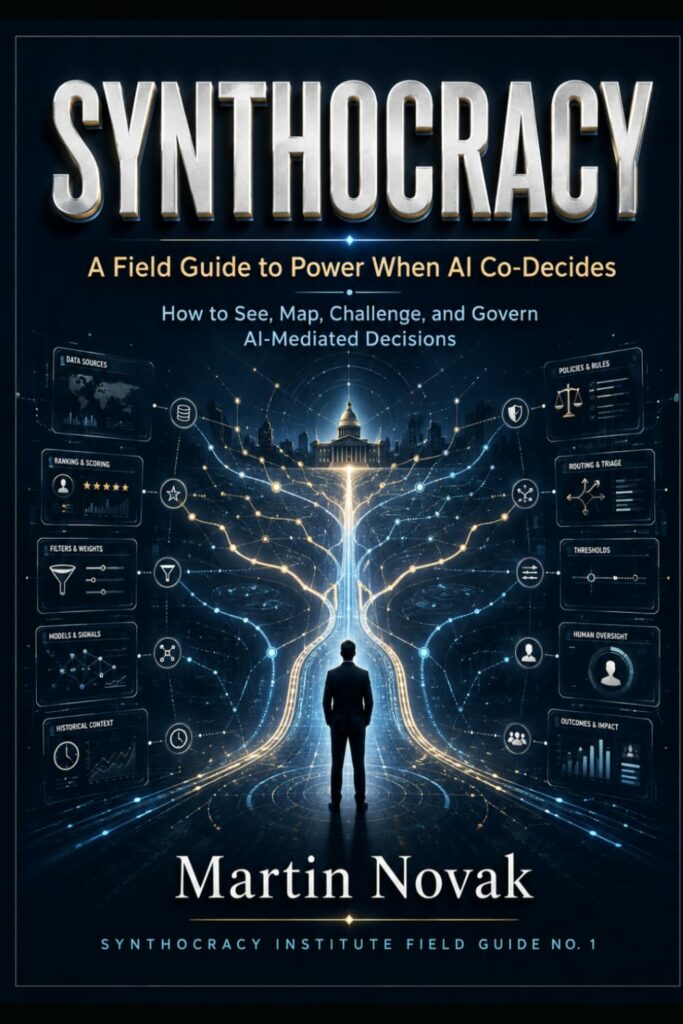









SYNTHOCRACY: A STEP-BY-STEP GUIDE. Synthocracy vs AI Governance, Technocracy, Algorithmic Governance, and AI-tocracy
The concept of synthocracy becomes useful only when it is clearly separated from the concepts that already surround it. Artificial intelligence did not arrive in an empty intellectual field. Long before the term synthocracy was given its present operational meaning by Martin Novak and the Synthocracy Institute, scholars, regulators, political theorists, public-administration researchers, technologists, and civil-society organisations were already studying automated decision-making, algorithmic governance, technocracy, platform power, human oversight, digital sovereignty, AI governance, surveillance, and machine-assisted administration. Synthocracy does not invalidate those literatures and should not be presented as if they had failed to notice everything that came before it. Its proposed contribution is narrower: it connects several established lines of inquiry through one recurring question—who actually participates in shaping a consequential decision when that decision passes through AI-mediated systems?
That distinction matters because adjacent concepts often become blurred in public discussion. Automation is treated as governance. AI governance is reduced to compliance. Technocracy is confused with machine rule. Algorithmic administration is treated as if it described every form of AI-mediated power. Sovereign AI is mistaken for political sovereignty. AI-tocracy is sometimes used as though every use of AI by government were inherently authoritarian. The conceptual map developed in the Synthocracy corpus is designed precisely to avoid those collapses. Its purpose is not to force all existing fields under a new label, but to identify what each field sees particularly well and what additional question becomes visible when we follow decision power across the entire human–machine chain.
SYNTHOCRACY — In the sense developed by Martin Novak and the Synthocracy Institute, synthocracy is a decision order in which humans formally retain authority and responsibility while AI systems increasingly shape or perform consequential operations upstream of, within, and downstream of decisions—including detecting, filtering, ranking, classifying, recommending, routing, drafting, and executing.
The core difference is therefore one of direction of inquiry. AI governance generally asks how institutions should govern AI. Synthocracy asks how the participation of AI changes the distribution of institutional decision power. Technocracy asks which human experts should influence or govern decisions. Synthocracy asks what happens when part of that expert, analytical, classificatory, or executive function migrates into synthetic systems. Algorithmic governance asks how rule and administration are organised through algorithms. Synthocracy takes that foundation and extends the analysis across public institutions, private firms, platforms, infrastructure providers, model laboratories, markets, and agentic systems. AI-tocracy examines the authoritarian use of AI. Synthocracy treats that as one possible trajectory of AI-mediated power, not as the definition of the entire phenomenon. Sovereign AI asks who controls the infrastructure and capability. Synthocracy asks how that infrastructure participates in consequential decisions.
Technocracy: Who Has Expertise?
Technocracy is one of the easiest neighbouring concepts to confuse with synthocracy because both involve technical knowledge and complex systems. But their basic structures are different.
TECHNOCRACY — A political or administrative arrangement in which governing influence is assigned to human experts because of their specialised knowledge, training, professional competence, or technical expertise.
In a technocratic arrangement, economists may guide monetary policy, engineers may shape infrastructure strategy, epidemiologists may influence health policy, military specialists may guide defence planning, and technical regulators may make decisions ordinary citizens cannot easily evaluate directly. The justification for their influence rests on human expertise: they know more about a specialised subject because they have training, experience, access to data, institutional position, or professional competence. A technocratic system can be democratic or undemocratic, effective or ineffective, accountable or insulated, but its central actor remains the human expert.
Synthocracy begins to describe something different when part of the expert function is transferred into systems. The civil servant still occupies the office, the doctor still sees the patient, the manager still attends the meeting, and the analyst still signs the report, but a model may classify the evidence, identify the anomalies, rank the risks, summarise the available material, propose the recommendation, or determine which cases deserve human attention first. The human expert has not necessarily disappeared. What may have changed is the analytical centre of gravity.
This gives us a concise distinction:
Technocracy asks: Which humans possess the expertise to guide decisions? Synthocracy asks: How much of the practical work of expertise and decision shaping has moved into synthetic systems, and what authority follows from that movement?
A technocratic ministry can therefore also be synthocratic. Imagine a department staffed by highly trained policy professionals. It uses a predictive model to identify high-risk cases, an AI system to summarise files, a ranking engine to allocate inspection resources, and a generative system to draft recommended actions. The officials remain experts. The administration remains formally human. Yet the practical environment in which their expertise is exercised has become partially synthetic. Technocracy and synthocracy are not mutually exclusive. They describe different dimensions of the same institution.
AI Governance: How Do We Govern AI?
AI governance is even closer to synthocracy, but the two concepts still point in different directions.
AI GOVERNANCE — The field concerned with how AI systems should be designed, assessed, controlled, monitored, deployed, regulated, audited, secured, and held accountable.
AI governance asks questions about risk management, safety, fairness, transparency, reliability, human oversight, documentation, compliance, testing, audit, cybersecurity, deployment controls, responsibility, and institutional procedures. These questions are indispensable. Synthocracy research explicitly belongs in conversation with this field rather than claiming to supersede it.
The difference becomes clearer if we compare two questions.
An AI-governance review may ask: Was the model properly tested? Was the risk assessment completed? Are the outputs monitored? Is human oversight available? Are the required logs maintained?
A synthocracy analysis asks: What did the system actually do inside the decision process? Did it determine what the human saw? Did it rank the candidates? Did it change which evidence counted? Did it set the default recommendation? Could the human realistically reconstruct and reject its conclusion? Who had authority to stop the process? What route did the affected person have to challenge the outcome?
The first set of questions concerns governing AI. The second concerns AI-mediated governance of people, resources, opportunities, risks, and institutional action.
AI governance asks: How do institutions govern AI? Synthocracy asks: How does AI participation reconfigure institutional decision power?
This distinction is important because an organisation can possess sophisticated AI-governance procedures while still creating a highly consequential decision architecture. A recruitment model may be documented, monitored, tested, approved, and compliant with internal governance policies, yet still determine which applicants ever become visible to a recruiter. A public agency may conduct a formal risk assessment before deploying an AI tool, yet the system may still become the primary mechanism through which cases are prioritised. Governance controls can be necessary and valuable without answering the entire question of where effective decision power has moved.
The Synthocracy corpus therefore draws a useful distinction between controlling AI and understanding AI-mediated control. The former is a central task of AI governance. The latter requires reconstructing the architecture of attention, evidence, eligibility, ranking, visibility, speed, default action, and remedy inside a decision chain.
Algorithmic Governance and the Algorithmic State: How Does Administration Use Algorithms?
Algorithmic governance is an established family of research concerned with the ways algorithms structure administration, regulation, classification, allocation, monitoring, enforcement, and social ordering. The related idea of the algorithmic state focuses more specifically on public institutions using computational systems within government and administration.
ALGORITHMIC GOVERNANCE — The study and practice of governing, administering, classifying, allocating, monitoring, or regulating through algorithmic systems.
THE ALGORITHMIC STATE — A state in which computational systems increasingly participate in public administration, including areas such as benefits, taxation, policing, immigration, public services, risk assessment, resource allocation, and regulatory enforcement.
These concepts provide essential foundations for Synthocracy research. They already direct attention away from the simplistic image of a computer issuing a final verdict and toward the wider administrative machinery surrounding the decision. The Institute’s own Definition Note explicitly acknowledges this intellectual inheritance.
The difference is mainly one of scope and analytical emphasis. Algorithmic governance is often associated with public administration, institutional rule, and algorithmic systems. Synthocracy deliberately extends the same power question into environments that do not look like government: employers, insurers, banks, marketplaces, search systems, recommendation platforms, cloud providers, model laboratories, agent registries, commercial infrastructures, and AI-mediated markets.
A private platform can shape visibility without being a state. A recruitment system can determine access to employment without being a government agency. A credit-scoring infrastructure can affect economic opportunity. A marketplace can determine which sellers enter an agent’s consideration set. A cloud provider can impose technical conditions on what another institution can deploy. A frontier-model provider can become an infrastructure dependency for organisations that formally retain their own authority.
This does not make every private platform a government. The claim is more precise: decision-order functions are not confined to the state. Classification, prioritisation, routing, visibility, eligibility, and execution can become forms of consequential power wherever they materially shape what happens to people or organisations.
The algorithmic state asks: How does public administration use computational systems? Synthocracy asks the broader question: Where does decision-shaping power move across public, private, platform, market, and infrastructure environments when AI enters the chain?
The two lenses therefore overlap strongly inside government, but synthocracy is deliberately wider than public administration.
AI-tocracy: When AI Strengthens Unanswerable Power
AI-tocracy describes a darker and more specific phenomenon.
AI-TOCRACY — An authoritarian or coercive configuration in which AI capability strengthens surveillance, prediction, censorship, behavioural control, repression, or other forms of power that become less transparent, less contestable, and less answerable to those affected.
Within the Synthocracy corpus, AI-tocracy includes possible uses such as predictive policing, population monitoring, automated censorship, biometric surveillance, social scoring, automated blacklists, protest anticipation, targeted intimidation, and AI-assisted manipulation of public opinion. Its defining issue is not simply that a government uses AI. It is that AI makes control more continuous, granular, predictive, coercive, or difficult to challenge.
AI-tocracy is therefore not another word for synthocracy.
Synthocracy describes the broader structural condition in which AI participates in consequential decision power. AI-tocracy describes one possible political direction that this condition can take. A synthocratic arrangement may support administrative efficiency, medical review, citizen services, democratic consultation, auditing, or accessibility. Another may produce opaque scoring, pervasive surveillance, automated suspicion, and weakened appeal. The diagnostic category should not prejudge all of these arrangements as identical.
A useful relationship can be stated simply:
Every AI-tocratic system would involve synthocratic mechanisms, because AI is materially participating in power. But not every synthocratic system is AI-tocratic.
The distinction protects the concept from becoming automatically dystopian. If synthocracy meant only authoritarian machine rule, it would merely rename a subset of surveillance-state and authoritarian-AI research. Its wider analytical value lies precisely in examining the decision layer before we know whether a particular configuration is beneficial, harmful, democratic, authoritarian, effective, illegitimate, reversible, or captured.
Sovereign AI: Who Controls the Infrastructure?
Sovereign AI concerns another form of power entirely: technological dependency.
SOVEREIGN AI — The pursuit of sufficient control over AI models, compute, data, technical infrastructure, platforms, and related capabilities so that a state, region, institution, or other actor is not wholly dependent on external providers for strategically important AI capacity.
This concept asks who owns or controls the technological foundation. A state that depends on foreign chips, cloud providers, frontier models, data pipelines, or safety policies can discover that part of its practical capacity rests on decisions made outside its own jurisdiction. Infrastructure dependency therefore has obvious political consequences.
Yet infrastructure sovereignty does not by itself answer the synthocratic question. A domestically owned model may still be opaque. A nationally controlled platform may still produce unchallengeable classifications. A sovereign AI system may centralise surveillance or decision power. Conversely, a foreign technology can, in principle, be used within a narrow, inspectable, auditable, and reversible decision process.
Sovereign AI asks: Who controls the infrastructure and capability? Synthocracy asks: How does that infrastructure participate in decisions, and who can inspect, challenge, suspend, correct, or reverse its effects?
Ownership is therefore one dimension of power, but not the whole of decision authority.
Why These Concepts Often Appear Together
The categories become especially useful when they are combined in one realistic institutional example.
Imagine a government ministry run by highly specialised economists and administrators. That is the technocratic element.
The ministry deploys AI under formal policies covering testing, documentation, risk assessment, oversight, and auditing. That is AI governance.
The system classifies applications, calculates risk scores, ranks cases, recommends investigations, and routes citizens through different administrative workflows. That is part of the algorithmic state and algorithmic governance.
The models run on domestic infrastructure because the government wants to reduce dependency on foreign providers. That is the sovereign AI dimension.
If the same infrastructure is then used for pervasive surveillance, automated suspicion, political profiling, censorship, or weakening the practical ability to appeal, the arrangement may begin to display AI-tocratic characteristics.
Synthocracy asks a question that cuts across all five descriptions: where is consequential decision power actually located within this combined system? Which operations remain substantively human? Which have become computational? Who determines the criteria? What enters the evidence base? What does the official actually see? Can the recommendation be rejected? Who controls the model? Who can stop the workflow? Can the citizen challenge the route as well as the final decision?
The concepts are therefore not competitors. They are different coordinates.
The Conceptual Map in Six Questions
The Synthocracy corpus condenses the distinction into six questions:
Technocracy asks: Who has expertise?
AI governance asks: How do we control AI systems?
The algorithmic state asks: How does administration use algorithms?
AI-tocracy asks: How does AI strengthen authoritarian power?
Sovereign AI asks: Who controls the infrastructure and capability?
Synthocracy asks: Who really co-decides when consequential decisions pass through AI?
This is not a hierarchy in which Synthocracy sits “above” the established fields. The Institute’s own definition note explicitly rejects that posture. Synthocracy research should remain in conversation with automated decision-making, algorithmic governance, human oversight, contestability, provenance, agent governance, platform-power research, and the wider AI-governance literature. Its strongest claim is not that these fields have failed, but that their insights can be connected through an operational question: who actually shaped the consequential decision, under whose authority, and with what route of challenge?
What Synthocracy Adds
The specific contribution of Synthocracy can now be stated more precisely.
It places formal authority and practical decision shaping side by side.
A legal document may tell us who formally decided. A system architecture may tell us which model produced a score. A provenance record may tell us which system generated an output. A governance framework may tell us who was responsible for oversight. Synthocracy asks how those layers interact in the actual decision episode.
Did a person formally hold authority while the system determined admission? Did the human reviewer technically possess an override while the workflow made independent review unrealistic? Did a ranking system determine what became visible? Did an infrastructure provider indirectly determine which capabilities were available? Did a platform shape economic opportunity through routing rather than explicit prohibition? Did an agent act within delegated authority, and can that delegation be reconstructed?
This is why the preferred unit of analysis in Synthocracy research is not an entire society labelled “synthocratic” in the abstract. It is the decision episode: a consequential object, the institutional actors involved, the formal source of authority, the evidence inputs, the computational and human operations, the output or action, and the route for review, challenge, correction, or reversal.
That methodological choice protects the concept against overreach. Instead of claiming that “we already live under Synthocracy” as though one unified political regime had replaced democracy, markets, firms, and bureaucracies, the framework asks whether specific decision chains contain synthocratic mechanisms and, if so, where.
Capability Is Not Authority
One final distinction separates Synthocracy from both utopian and dystopian ideas of machine government.
CAPABILITY IS NOT AUTHORITY — A system may be faster, more accurate, more consistent, or more capable than a human in a particular task without thereby acquiring the right to govern, define the public interest, or make its outputs immune from challenge.
This principle matters because debates about advanced AI easily slide from performance into legitimacy. If a model predicts better than a person, should it decide? If an agent coordinates resources better than officials, should authority simply migrate toward the more capable system? Synthocracy does not answer that question by assuming either yes or no. It first insists that the transition be made visible. Superior capability may justify using a system as evidence, advice, analysis, or delegated machinery. It does not automatically establish the legitimacy of the authority exercised through it.
That is why the framework is diagnostic before it is normative.
The Difference in One Example
Consider again an AI-assisted recruitment process.
Technocracy asks whether qualified HR professionals, labour experts, or organisational specialists have sufficient expertise to design and supervise recruitment.
AI governance asks whether the recruitment model is properly tested, documented, monitored, audited, and controlled.
Algorithmic governance examines how algorithmic classification and ranking structure the recruitment process.
AI-tocracy would become relevant if similar systems were used coercively—for example, to create pervasive worker surveillance, political blacklists, or unchallengeable behavioural classifications.
Sovereign AI would ask who owns and controls the model, data, infrastructure, and computational capability.
Synthocracy asks: before the recruiter made the final decision, did the AI determine which candidates the recruiter ever saw, how those candidates were ranked, which attributes were treated as relevant, and which applicants disappeared from consideration? If so, where did effective decision-shaping power reside?
That is the distinctive question.
Why the Map Matters
Conceptual precision is not merely an academic exercise. Different problems require different remedies. A lack of national compute capacity cannot be solved by improving an appeals process. A weak appeals process cannot be solved by domestic model ownership. An opaque ranking system cannot be made accountable merely by declaring that a human remains in the loop. Authoritarian surveillance cannot be understood simply as a compliance failure. Poor AI governance and concentrated decision power can coexist, but they are not identical problems.
The map allows us to ask the right question at the right layer.
Technocracy helps us examine expertise. AI governance helps us govern the technology. Algorithmic-governance research helps us understand computational administration. Sovereign AI helps us understand technological dependency. AI-tocracy helps us identify authoritarian uses of AI. Synthocracy connects these perspectives when the issue is the redistribution of consequential decision power through synthetic mediation.
The central rule remains the same as in Article 1:
Do not ask only whether AI made the final decision. Ask how AI changed the conditions under which the decision became possible, reasonable, visible, likely, default, or executable—and who retained the authority to inspect, challenge, stop, and reverse what followed.
That is the boundary of the concept.
And it prepares us for the next question in the series: when exactly does ordinary AI assistance cross the line into co-decision?