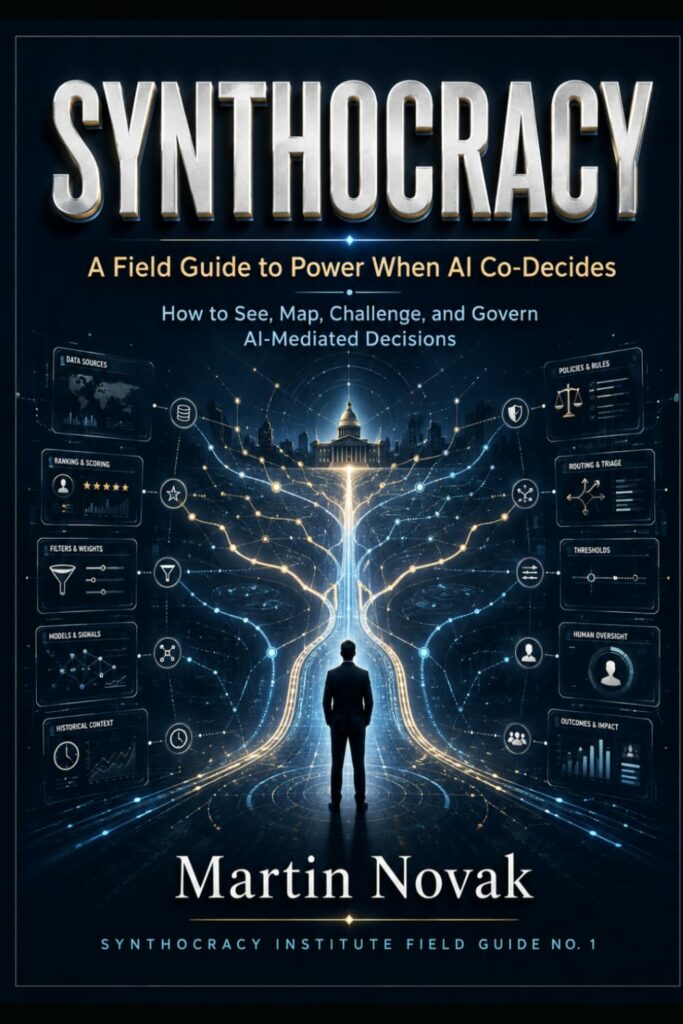









SYNTHOCRACY: A STEP-BY-STEP GUIDE. What Is Synthocracy? A Step-by-Step Introduction
Artificial intelligence is usually discussed as a technology problem. We ask how intelligent models are, what work they can automate, whether they make mistakes, how they should be regulated, and whether humans can keep them under control. Synthocracy begins from a different question: what happens to power when AI becomes part of the process through which decisions are prepared, shaped, authorised, and executed? The question matters because a system does not need to issue the final decision to influence what happens. It may decide what information is visible, which cases receive attention, how people are classified, which candidates are ranked first, which risks are highlighted, what recommendation reaches the human decision-maker, which option becomes the default, or which action is executed after approval. The human may still sign. The institution may still formally decide. Yet part of the practical work of deciding has already moved elsewhere. This is the condition that the concept of synthocracy is intended to make visible.
ONE-SENTENCE DEFINITION — Synthocracy is a decision order in which humans formally remain in authority and responsible for outcomes while AI systems materially shape what is detected, seen, ranked, recommended, routed, approved, or executed.
The central idea is simple: power does not disappear when a decision passes through an AI system. It changes interface. A visible act of authority may remain human while consequential influence moves upstream into databases, models, rankings, dashboards, recommendation systems, automated workflows, agents, and technical rules. The political or organisational surface may therefore look familiar even while the machinery underneath it changes. A manager still approves. A doctor still decides. A public official still signs. A customer still chooses. A citizen still receives a formal administrative decision. What has changed is the environment from which those decisions emerge.
The Expanded Definition
EXPANDED DEFINITION — In the sense developed by Martin Novak and the Synthocracy Institute, synthocracy is a decision order in which humans formally continue to govern, manage, vote, approve, or bear responsibility while consequential operations within the decision chain—such as detecting, filtering, classifying, scoring, ranking, summarising, prioritising, recommending, routing, authorising, or executing—are increasingly performed or materially shaped by AI systems, predictive models, agents, data infrastructures, and digital platforms.
This definition deliberately does not say “rule by AI.” That phrase is too narrow and arrives too late. It invites us to imagine a spectacular future in which an artificial intelligence openly replaces a president, minister, judge, executive, or other human authority. Such a scenario may belong to political theory or foresight, but it is not necessary for synthocracy to exist. The more immediate transformation is quieter. AI can acquire practical influence without acquiring a constitutional title, legal personality, political office, or formal right to govern. It can influence the decision by shaping the conditions under which another actor makes it.
This distinction is the foundation of the entire Synthocracy framework. If we define machine power only by asking “Did AI make the final decision?”, we overlook much of the decision process. A system can determine which information reaches a decision-maker without making the decision itself. It can rank candidates without hiring anyone. It can identify high-risk cases without issuing a sanction. It can summarise evidence without delivering the judgment. It can recommend one medical pathway without treating the patient. It can decide which products are visible without purchasing anything. It can route a complaint into one workflow rather than another without formally rejecting the complaint. The final action may remain human, but the pathway leading to it is already partly synthetic.
Step 1: Start With the Visible Decision
The easiest way to understand synthocracy is to begin with an ordinary decision. Imagine a company recruiting for a position. A human recruiter conducts interviews and formally decides whom to hire. If we examine only the end of the process, the conclusion seems obvious: a human made the decision.
Now move one step backward.
Before the recruiter sees the candidates, an AI-supported recruitment system processes the applications. It extracts information from CVs, evaluates relevance, applies criteria, produces scores, ranks applicants, and presents the recruiter with a shortlist. The recruiter may genuinely choose among the people on that list. But hundreds of other applicants may never become visible to the human decision-maker.
Did the AI hire anyone? No.
Did the AI materially participate in the decision? Potentially, yes.
This is the simplest synthocratic example because it reveals the difference between formal decision authority and practical decision shaping. The human decides among the candidates the system presents. The system helps determine who enters the field from which the human chooses. The decision is therefore not located only at the moment of final approval. Part of it occurred earlier, in the construction of the choice set.
Step 2: Move Upstream
Once we look upstream, the apparent simplicity of many decisions disappears. Before a person signs, approves, accepts, rejects, diagnoses, selects, investigates, or pays, several earlier operations may already have shaped the outcome. Someone or something determined what data counted. A model classified the case. A threshold separated ordinary from high risk. A ranking established priority. A summariser reduced a large file to a shorter representation. A recommender proposed an action. A workflow routed the case to one team rather than another.
None of these operations needs to be called a “decision” inside the organisation. They may be described as analytics, productivity, workflow optimisation, decision support, fraud prevention, personalisation, triage, prioritisation, recommendation, or administrative assistance. But names do not determine effects. The Synthocracy approach therefore asks not only what a system is called, but what it materially changes in the path to an outcome.
This leads to one of the most important rules of the framework:
AI does not need to make the final decision in order to co-decide. It is enough for the system to materially shape the path, evidence, priorities, options, recommendations, routing, or execution through which the consequential decision is produced.
Step 3: Notice That Power Can Govern Attention
Traditional images of power emphasise commands: an authority tells someone what to do. But an increasingly important form of power works earlier. It influences what becomes available to be considered at all.
A ranking governs attention. A filter governs visibility. A risk score governs scrutiny. A recommendation governs the default direction of action. A summary governs which parts of a complex record remain cognitively available. A routing system governs which process a person enters. A recommender can govern exposure without prohibiting anything. An automated queue can govern time without formally denying access.
This is why synthocracy is broader than automated decision-making in the narrow sense. The important question is not always whether a machine issued a yes or no. It may be whether the machine determined what the human saw before saying yes or no.
The decision field can therefore become AI-mediated while the final gesture remains recognisably human. This is the deeper meaning of the principle that power changes interface. The authority may still appear on the surface as a person, office, company, institution, or citizen. But part of the structure producing the decision has moved into systems that detect, select, order, compress, predict, and route reality before the human acts.
Step 4: Understand Why the Human Does Not Disappear
Synthocracy is not a theory of human disappearance. In many synthocratic arrangements, the opposite happens: humans remain extremely visible. They approve transactions, sign letters, explain decisions, appear before courts, meet patients, dismiss employees, respond to complaints, and carry formal responsibility.
The problem is that visibility is not the same as control.
A human may remain at the final surface while important elements of the decision architecture lie elsewhere. Life Under Synthocracy describes this condition as agency becoming interface: the person continues to click, choose, approve, reject, appeal, and confirm, but the field within which those actions occur may already have been prepared by rankings, recommendations, defaults, queues, and machine-generated representations.
This is why the presence of a human cannot by itself settle the governance question. “A human approved it” tells us something, but not enough. We also need to know what that person saw, what the system had already filtered out, whether alternatives were available, whether the recommendation could realistically be rejected, whether the human had time and competence to review the case, and whether intervention was still capable of changing the result. Later articles in this series will develop these questions into the concepts of the Ceremonial Human, meaningful human decision authority, and decision-chain evidence.
Step 5: Understand Why We Need a New Word
Why not simply call all of this automation, AI governance, algorithmic decision-making, or artificial intelligence?
Because each term answers a somewhat different question.
Automation primarily describes the transfer of tasks or processes to machines. AI governance usually concerns the rules, institutions, standards, controls, and responsibilities surrounding AI systems. Automated decision-making focuses on decisions generated or substantially influenced by automated processing. Algorithmic governance examines the role of algorithms in administration and social ordering. Human oversight asks whether people can supervise and intervene in automated processes.
Synthocracy is intended to add a specific analytical lens: where does decision power move when AI enters the chain, even when formal authority remains human?
The term is useful only if that lens reveals something that established categories can otherwise make difficult to see. It should therefore not become a replacement word for every existing field. The Synthocracy Institute’s own methodological rule is explicit: established concepts such as human oversight, contestability, traceability, authorisation, delegation, and reversibility should not be renamed merely to create a proprietary vocabulary.
Synthocracy instead names the larger configuration in which these individual governance problems become connected. It asks how formal authority, operational influence, responsibility, visibility, routing, delegation, and the ability to challenge an outcome are distributed across a human–machine decision system.
Step 6: Understand the Word Itself
The word combines two intuitive components. Synth- points toward the synthetic, computational, artificial, model-mediated, or machine-generated layer of decision processes. It is not limited to generative AI. The relevant systems may include predictive models, classifiers, scoring systems, recommender systems, AI agents, decision-support tools, data infrastructures, automated workflows, simulation systems, and digital platforms. -cracy points toward rule, power, governance, or the ordering of decisions. Taken together, the word suggests an order in which synthetic systems become involved in the organisation of consequential choice.
But the etymology should not be exaggerated into a claim of ownership or historical priority. The Institute’s research into the term found earlier and parallel public uses. A clearly dated use identified in that review appeared in 2024 in Steffen Reckert’s Solon AI: Crafting a Synthocracy, where the term described a prospective form of AI-enhanced government. Frank Carbullido used the word in 2025 in a broader values-driven vision of AI-enhanced governance, and other online uses connected it with participatory governance, decentralisation, and related models. The specific contribution developed by Martin Novak in 2026 is different: it defines synthocracy as a decision order characterised by the separation between formal human authority and increasingly AI-mediated practical decision shaping. The Institute therefore treats this as the Novak definition of synthocracy, not as an uncontested claim to the invention of the word.
That distinction is important. Synthocracy should earn analytical value through usefulness, evidence, and precision, not through mythology about the origin of a term.
Step 7: Do Not Call Every Use of AI Synthocracy
If every interaction with AI qualifies as synthocracy, the concept becomes useless.
Using AI to correct grammar does not normally constitute co-decision. Translating a document, formatting a spreadsheet, or helping someone locate a public form may be ordinary assistance. The presence of AI is therefore not the threshold.
The relevant threshold is material influence on a consequential decision environment.
A useful first test is to ask whether the system materially changes what someone sees, what is hidden, who is ranked, which evidence is considered, what receives priority, which route becomes available, what recommendation is produced, or what action is executed. This is not a perfect legal or scientific test, and later articles will refine it. But it prevents two opposite errors. The first is to label every AI tool as an instrument of governance. The second is to wait until machines independently exercise sovereign authority before acknowledging that decision power has already begun to move. The operational Synthocracy programme deliberately occupies the space between these extremes.
AI-mediated decisions can also be beneficial. Automated systems may reduce delays, identify relevant information, improve consistency, detect patterns humans miss, make services more accessible, or reduce some forms of arbitrary human judgment. Synthocracy is therefore diagnostic rather than inherently accusatory. It does not begin by declaring AI-mediated power legitimate or illegitimate. It begins by making the distribution of power visible enough to examine.
Step 8: Follow the Power, Not the Interface
The most important practical habit in Synthocracy research is therefore simple: follow the decision chain.
When a consequential outcome occurs, do not stop at the person whose name appears on the letter, screen, contract, judgment, medical record, recommendation, or approval. Move backward. Ask what determined the available evidence. Ask who defined the criteria. Ask what model classified the case. Ask what disappeared during filtering. Ask what ranking controlled attention. Ask whether a summary replaced the underlying record. Ask whether a recommendation became a default. Ask whether a human could realistically disagree. Ask where the action was executed. Then move forward again: what happened to the person affected, what appeal existed, what could be corrected, and whether the path can later be reconstructed.
The question changes from:
Who signed the decision?
to:
Who—or what—shaped the path through which the decision became possible?
That is the basic move of Synthocracy.
What Synthocracy Is Not
Synthocracy is not synonymous with an AI dictatorship. It does not require machines to possess political intentions, consciousness, legal rights, or sovereign status. It is not a claim that democracy has already ended, that human institutions no longer matter, or that one global synthocratic system governs the world. It is not a theory that all automation is harmful. Nor is it a substitute for established fields such as algorithmic governance, automated decision-making, AI governance, human oversight, contestability, or provenance. It is a proposed analytical framework for examining a particular structural problem that increasingly cuts across these fields: formal authority may remain in one place while effective decision-shaping power moves elsewhere.
The Simplest Example
Return to the recruiter.
The recruiter signs off on the shortlist and conducts the interviews. Formally, the recruiter decides.
The AI system has already scored 2,000 applications and selected 40 for human review.
Thirty-nine applicants are interviewed or rejected by a human. The remaining 1,960 are never considered by one.
The system has not replaced the recruiter. It has changed the meaning of the recruiter’s decision.
That is the simplest way to understand synthocracy.
The decisive question is not whether a machine occupied the human’s chair. It is whether the chair still commands the same field of reality.
Why the Concept Matters
The most consequential transformations of governance do not always announce themselves as transfers of power. They may arrive as productivity features, recommendation engines, dashboards, automated summaries, safety systems, fraud detection, personalised services, smart workflows, decision support, or AI agents. Each may be useful. But usefulness does not eliminate the need to ask where authority, influence, and accountability now reside.
Synthocracy gives us a vocabulary for asking that question before machine involvement becomes so normal that the distribution of power disappears behind the interface.
The first principle of this guide can therefore be stated plainly:
POWER DOES NOT DISAPPEAR. IT CHANGES INTERFACE. When AI enters a consequential decision chain, the central governance question is not only whether a human remains present. It is where the power to shape the decision has moved, who can still inspect it, who can challenge it, and who can stop or reverse what follows.
That is what Synthocracy studies.
And it is the starting point for everything that follows.